Sunday, March 18, 2012

Tales from Rural Maine: Signs of life

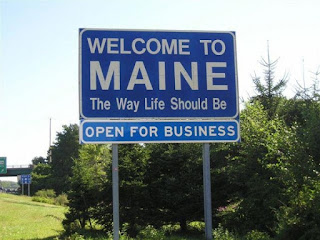
As most New Englanders know, there is a large, but modest sign (at least in appearance) posted at the southernmost border of my home state intended to welcome visitors as they zoom into Maine on I-95 North from points unknown. "Maine The Way Life Should Be," it says.

(Facebook photo)

The sign has stood for as long as I can remember, inspiring sighs and grumbles from those of us who live here full-time, throughout the long, cold winters with sky-high heating costs and the other truths of real life in Maine, such as the highest health care costs in the nation, the highest per capita gun ownership, and no civil partnership or marriage rights for anyone except heterosexual couples. Only 25% of Mainers have a college education. Is that really the way life should be? Guns, mosquitoes, missing teeth, plastic-coated windows, menial labor and untreated illnesses are not what the authors of the sign meant to convey when they posted it. One imagines that the authors of the sign intended to conjure the simple thought: "Life should be like your vacation." Maine is, after all, Vacationland. It says so on our license plates.

Last year, our repugnant (or "industrious, pro-business," if you prefer) Tea Party governor, Paul LePage, amended the iconic sign. Why he had the right to use private funds to amend our Welcome to Maine sign, I'm not sure, but now, dangling from beneath this giant symbol of what Maine is meant to mean to others, there is a tinier sign, an afterthought tacked on, which looks (and metaphorically smells) very much like, as we say here in Maine, a dingleberry. The dingleberry reads, "Open For Business."

The sign is beloved by some in the business community and was, in fact, purchased with contributions made by LePage supporters and affixed after LePage's election, as a sort of trophy. LePage did not win a majority of the votes, by the way; most of the state voted for the Independent and Democratic candidates, but he is our governor, nonetheless.

Not long after the "Open For Business" addendum was added, it was removed by persons unknown. Eventually, funds were raised by "a group of businessmen" and a replacement "Open For Business" sign was tacked onto the bottom of The Way Life Should Be again. (This author would argue that the money they raised would be better spent on a scholarship to help some aspiring college student buy his or her books for the year, but hey, I'm not the governor or a lobbyist for the Maine Aggregate Association.)

(Facebook photo)

Now, as tourists zoom into the state to spend money on ski weekends and lobster and mosquito repellent, they are greeted with the message, "Welcome to Maine The Way Life Should Be Open For Business."
I feel a little sick even writing the words here that appear on that sign. It smacks of desperation, of commerce--there is something so coarse and...impure?...about this message. Your life should be open for business? Really?
Whereas before, one might drive past the sign and imagine a seaside clam bake or sunrise over Bar Harbor, it now feels as though we've crashed those dreams into a utility pole bearing a For Sale sign. The view from camp now has a Help Wanted sign slapped across it. A sign which says, "No, *seriously*, we're desperate. Bring your business here. Exploit our resources. Employ our people. Spend your money. Your help is WANTED."
It's crass and sad and it's not the way life should be. Although, I guess, these days, it may be the way life is. 
As an 8th-generation Mainer, I feel qualified to say that, honestly, the original sign has always irked me, since life in Maine is not the way life should be, but the affront of this new "open for business" appendage has really shifted my gentle distaste to something closer to outrage. At least before I knew they were selling a vision of Maine as Vacationland, but what (exactly?) are they selling now? Plus, let's face it, it wouldn't be very Mainer of me to think someone else can tell me how my life should be, in the first place. (My best guess is that whoever thought up that slogan was from away.) But, as any good Maine girl will be, I am possessed of some Yankee ingenuity. I am not about to point out a problem without offering a solution.
As a counter to this iconic and problematic Welcome to Maine sign, I offer two actual signs I drove past recently in the small mid-coast town of Searsport. One was in front of the fire department, the other at a church. They embody for me more of the true spirit of life in Maine and, with the exception of eating poultry, which no one would do in my version of the way life should be, these two signs do a better job of expressing how life should be than that sign at the border with its shiny, new Tea Party dingleberry.

The Searsport signs, to wit: 

"God is always eager
to listen turkey
supper Mar 10"

-and-

"Time to have your field
burned."

Welcome to Maine.

Naomi Graychase is a writer and yoga teacher who lives in the same small Maine milltown in which her forefolks have lived since they finished fighting the Revolutionary War and came North in 1809. 

Labels: , , , , , , ,

Tuesday, May 29, 2007

Church Signs: "Coming Home"

Last Tuesday was the 13th anniversary of my graduation from college. I decided to mark the occasion by writing a letter to my closest friends, "coming out" as it were, about my struggles, and asking for their help in finding my way to a life that works.

I have been committed for most of these last thirteen years to hiding my flaws, covering up my mistakes, grinning madly through my misery, and pretending everything is okay. I'm quick to scribble in a silver-colored lining to every cloud, and then lie about its extraordinary virtues. This approach has left me feeling alienated, unprotected, misunderstood, and ashamed—because I am both a liar and a failure.

As part of the Year of Healing, I felt it was time to come clean. To admit to these women I love and respect—and who love and respect me—that I have had a great deal of trouble staying alive. That any happiness they may have perceived, any success, was either short-lived or a false front. I have been afraid to visit with them or talk to them or to keep in touch because I was in so much pain. I was afraid that they would see it.

I decided to write to them to accomplish several things. First, the wise, loving part of my psyche suggested that these are people who would love an opportunity to help, to be included; they are the kind of friends who wish you would turn to them when you need something. So, I wanted to give them that opportunity; I wanted to open the door and invite them into my real life in a meaningful way.

Second, I thought they might actually be able to help. Because sometimes it is hard for us to fully see ourselves, I thought that perhaps one of them would have a vision of me that could work. Perhaps one of them had heard of a program, a book, a workshop, a person, a place, a movie--something that they thought I should experience. Perhaps there is some job they have always thought I would be perfect for. It was an inkling—an intuition—I had, to put this out there to them. I wanted to know what associations they made between me and a life of happiness. What did they see in that picture? How did they connect the dots? I trusted that if I panned through their imaginations, a chunk of gold could emerge.

Writing the letter was satisfying at first. It felt beautiful. I was able to find my words—or they found me. It was good to be reminded that I love writing because I hate (so much) the writing I do for work; and I hate the feeling of not knowing how to direct my skills into a format that earns me a living wage and satisfies my desire for a sense of purpose. But as I got to the second half of the letter, where I was honest about the extent to which my life has been at risk these last thirteen years, it seemed like too much to lay on them.

My third purpose in being forthright with them was so that, if I lost my battle to survive, they would not be totally taken aback. I wanted them to have some sense that it was a possibility, that I'd barely made it so far and that at any moment, I could completely fall through the cracks. I thought that if they were blindsided, it would seem so much more painful and confusing; they might blame themselves and wonder what they could have done to help. The letter was a way of gently, subtly, letting them know the truth, so that if they lost me altogether, it wouldn't come out of the blue.

Once it was finished, I realized this was too much to lay on them. It was depressing and intense, and knowing that I had nearly died so many times these last thirteen years, would sink their ships. It would cause so much concern that instead of offering the twinkling light of connection between things that might work for me, they would call and e-mail with grave concern, and I would be left fielding these calls, instead of following the light they might shine into my future.

So, I revised the letter. I addressed it to my entire class. (As Alumnae Class President, I can write to them all.) Instead of confessing my struggles and bracing my friends for my departure, or asking them for help and guidance, I offered a message to my classmates, a message of respect, encouragement, and compassion. I told them what I had been hoping to hear for all these years. Somehow, by being willing to reach out to my friends, to confess my weaknesses and my problems, I had discovered the truth I had been seeking for myself. I had set off for Oz, but then discovered the answer was right here at home.

Don't get me wrong. I am still struggling: my rent is due this week and I barely have it. I need a roommate, but don't want one and can't find one. I hate my job and have hated it for about thirteen years, so the cumulative drag is substantial. My love-life is a non-starter. (Two weeks ago I told the guy I've been seeing once or twice a month for the last few months that I'd like to see more of him and he said no.)

Yesterday, three days after making a $500 repair to my truck, the driver's side door wouldn't close. It has rusted to the point that the latch has broken off, which I expect is a very expensive thing to fix, since it would require body work. Yesterday, I drove around town with one arm out the window holding my door shut. Since I drive a standard, the other hand was busy shifting and steering. To really make things fantastic, a few weeks ago, my windshield wipers started going crazy every time I turn on my blinker; and if I turn it to the left, the blinker won't turn off after I've completed my turn. I have to do it manually. The cost of fixing the blinker/wiper fiasco is $250. So, for the time being, I will be holding the door shut with my left arm, while I shift, steer, and turn the blinkers (and windshield wipers!) on and off with my right. It's a good thing I'm coordinated.

But, here's the silver lining, and I promise this isn't just me coloring one in so that I can pretend things are better than they are: it's funny.

I mean, instead of feeling freaked out and depressed and suicidal and hopeless and like the bullshit and bad luck will never end, yesterday, as I was driving down the road, broke and single, less than a month from turning 35, with no roommate prospects and uncertain if I'd be able to pay my rent, let alone buy some groceries or a ticket to the movies, my debt growing like a cancer, avoiding thoughts of the tedious, low-paying, work I'm behind on, holding in the door with my left arm, as I attempted to steer, shift, brake, clutch, and turn the wipers off all at once with my remaining appendages, I laughed. I mean, I genuinely laughed. Out loud.

What used to make it not funny was the feeling that it would never end, that this poverty and isolation is life-threatening and there's no way out; it was the feeling that I am alone in my failure. Sure, I started out from a harder place than most, but I went to Smith. I should have parlayed that into something more. There are people living in trailer parks with nothing better than a GED in better financial shape than I'm in. There are people with degrees from community colleges or mediocre state schools who drank their way through school and slept through half their classes with more fulfilling and financially gratifying careers than mine. I have felt like I blew it and that's devastating. I have felt like such a waste of skin and space and education and love. (No wonder I was suicidal.)

But, the process of writing that supportive letter to my class was a little cathartic. I felt more stable and comforted afterwards. It gave me some perspective and access to my own wise, capable parts. And then, on top of that, there was an unexpected influx of letters from my classmates. 443 women received that e-mail. And, so far, about 50 of them have written back, along with some of their parents and friends and friends of friends to whom they forwarded the letter.

They've written some gorgeous e-mails, expressed sentiments that gave me goosebumps, and made me smile or laugh or cry. I have been embraced, and they have embraced one another—and themselves. It turns out, there were a lot of women like me who felt their lives weren't measuring up. Women who were struggling and feeling a little (or a lot) lost and alone. And now, we all feel a little less so.

We all started Smith with a common sense of optimism, determination, and purpose; there is a unity, a solidarity, that we call "the Smith experience." As we have journeyed off on our own courses, we have become increasingly disconnected from that. On the 13th anniversary of our commencement, I reached out and plugged us back in. I didn't have any ruby slippers, but I did have the keys on my keyboard. I clicked them together and said what I think is a modern translation of, "there's no place like home."

I said, "You are not alone." I said it to myself and I said it to them. And they returned the favor.

Below, you can read the original letter and some of the responses I received.

From: Naomi Graychase <graychase@gmail.com>
Date: May 23, 2007 2:00 PM
Subject: Happy Anniversary
To: Alumni <graychase@gmail.com>

My Dearest Classmates,

[I tried to send this note to you yesterday, but a glitch in the e-mail broadcast system prevented it from making it to you. C'est la vie.]

On this day, thirteen years ago, we stood in the blazing sun in black robes and white dresses (or pants suits) and sweated our knockers off while we waited to receive the hard-won diplomas of people who were not us. Then, when all the speeches were over and all the names had been called, we marched, dazedly, onto the grass in front of King and Scales, formed a spiraling circle, and passed our diplomas until we came up with our own.

It was the best of times, it was the worst of times. The next day remains in the Top Ten All-Time Worst Days Ever for me. I hope it does for you, as well. That would mean that you still love and miss one another, and also that your life hasn't really been that bad since you stopped singing gaudeamus igitur twice a year and eating Fisherperson's Platter.

Spring has been cold and slow to come fully into herself this season in Northampton. Ivy Day was chilly and rainy. But nevertheless, last weekend, the town was swarmed with women in white, with name tags and tote bags, and the wistful, determined expressions of people who have returned to a place that will always be familiar and yet somehow never be the same, people who have journeyed through time (and airports) to invite their past to meet their future...people who are trying to find a way to squeeze in one more trip to Herrell's before they catch their shuttle back to Bradley.

I hope that these thirteen years have treated you well; that what you learned at Smith, whether it was to remain open-minded when encountering the unfamiliar--such as grapes paired with brown sugar and sour cream for dessert--or to speak up and think hard about what you believe in, has stayed with you and helped you through every victory and every loss.

We never read in the pages of the Alumnae Quarterly about the other kinds of successes in our lives, the brave and beautiful ways we get ourselves through the bankruptcies, miscarriages, divorces, lay-offs, betrayals, illnesses, and the other ugly struggles that come to all of us eventually. I think that's sort of a shame. I consider these things to be the true successes in life; the moments when we rise up amidst adversity and make brave choices and fight our way through. That's the stuff I really wish we were sharing--not that promotions and vacations and babies aren't fantastic; I love hearing about them. But I'd also love to know more about the creative, enlightened ways that each of you has managed to navigate what has been difficult in your lives. How you got sober or recovered when your business failed or found the courage to drop out of medical school and disappoint your parents or leave your spouse or care for your sick mother or whatever it is that you've done bravely these last thirteen years.

Since we don't currently have a forum for exchanging those stories and ideas, I want to take a moment here, on the 22nd of May, 2007, to pause and to acknowledge that for every one of us who has earned her PhD or published six books or married a dreamboat or landed her dream job or bought her dream home or given birth to brilliant children, there are a lot more of us who got a little lost along the way; who made difficult choices between career and family; who quietly left marriages that weren't working or jobs that weren't right; who lost children, or couldn't have them, or had children who were sick. Some of us fled our homes when Hurricane Katrina hit, some of us fled for other reasons, and some of us are still searching for something that really feels like home. Some of us are sick and some of us are nursing spouses or children or parents who are fighting illnesses they may not defeat. And the courage, intelligence, compassion, and strength that these things take are worth applauding.

I hope that all of you are thriving and happy and healthy, but for those of you who aren't--don't let the Quarterly (or anything else) fool you. You are not alone. Whether you are plagued by ambivalence or something easier to diagnose, there is someone among us who is struggling like you.

In the diploma circle it took more time for some of us to find what we had earned than it did for others. If you are feeling lost, I hope you will hang in there, stay on your feet and keep passing to the right (as it were), and yours will come eventually. And if you are one of the ones that have already found the metaphorical diploma with your name on it, I hope you are whooping with delight and throwing your cap up in the air tonight.

Happy Anniversary.
xxoo
Naomi
--
Naomi Graychase
Alumnae Class President, 1994

Sample Responses:

Dear Naomi,

I am profoundly moved by your anniversary message. Thank you so much
for finding a graceful way to honor the diverse (and often, as you point
out, unspoken) paths we've all taken.

I made a few false starts at Smith and made a few more in the years
following my time there - a Master's in a field that incurred a lot of
debt but few professional prospects; some years spent thinking that my
job experience wasn't sufficient to earn a decent living (so I settled
for being woefully underpaid); time spent doubting, doubting, doubting.

But here I now sit at 36, feeling respected at work, making progress
towards a much more interesting Master's degree, and being exceptionally
content in my family situation and surrounded by friends old and new. I
am reminded again by your message that much of what I learned implicitly
during my time at Smith - speaking my mind in personal relationships,
classroom settings, and conference rooms, being able to interact
respectfully with a diverse group of people - continues to matter a
great deal in how I move through my day-to-day life, and I am grateful
for those implicit lessons.

Most of all, though, as I make plans to travel to the commitment
ceremony of two Smith friends this summer, and as I catch up over email
and phone with other Smith friends, I am reminded of how exceptionally
fortunate I was to be surrounded by so many remarkable women during
those fleeting and confused years, and am secure awed and inspired by
them - and all of us - to this day, in our mistakes and our triumphs.

Warm regards,
Kelley Smith

Naomi,

Your email is spot on, and eerily relevant. I spent the weekend with a
group of Smithies, one of whose husband is battling advanced brain cancer.
She was suffering, she called upon us, and six of us flew in at two weeks
notice from various points around the country to be with her to talk, laugh,
cry, and drink a whole lot of wine. It is an ugly thing which she is
experiencing, but it was so beautiful to see how the Smith sisterhood is
helping to sustain her through her ordeal.

Thank you so much for this fresh take on the thirteen years behind us.

Warm regards,
Melissa (Merten) Belleville '94

Naomi,
I'd like to say thank you for your anniversary wishes. I had two friends email your message to me at work before I even had a chance to find it in my own private email. I guess you could say it spread like wildfire. As I wrote to my friends after I read your words, "I felt a whole hell of a lot closer to the sisterhood of Smith in that moment than I have in a long time. I felt supported and part of a whole...not like I'm out here floundering on my own." I, in fact, cried - in that good, cathartic way. I am blessed with a wonderful life, but still have times of ambivalence, where I think I ought to be more. That perhaps I should be living up to the reputation of Smith. You remind me that I have. In every choice and decision I make (to leave a job, take on debt, leave a relationship), I act as a product of that wonderful environment. I am independent, intelligent, compassionate, and strong (whether I feel it or not). I am right where I should be, right where many of us are. It feels great to be reminded that I am part of a larger whole. That the sort of women Smith produces are exactly like me. I will keep making choices and may even pass to the right on some things until I find exactly what it is I'm looking for. I have no doubts my ribbon-wrapped diploma will arrive. So thank you for your anniversary wishes, I wish you double of the same!
Best regards,
Marcella Davis

Labels: ,

Monday, April 16, 2007

Church Signs: "Ready to Go Home"


I suffer from chronic pain on the right side of my body. The pain is mostly localized in one nickel-sized spot in the interior of my right knee and one half-dollar-sized spot my buttocks (in the center of my piriformis), although I also have pain in my inner thigh, under my right shoulder blade, and on my forearm, near my elbow. The upper body spots are explained by repetitive stress, I think; the others have been with me so long, it's hard to remember when they began.

Over the years, I've tried acupuncture, physical therapy, surgery, yoga, various types of exercise, special (expensive) types of shoes, orthotics, chiropractic care, stretching, anti-inflammatories, homeopathic remedies, and other alternative remedies. I have consulted with podiatrists, orthopedists, general practitioners, physical therapists, massage therapists, energy workers, acupuncturists, osteopaths, friends, relatives, books, psychotherapists, psychiatrists, and more. Nothing has worked. Not meditation. Not exercise. Not changes in diet. Not Tylenol, Advil, or Motrin. Not percoset, darvocet, codeine, or vicodin.

The severity of the pain varies from week to week, but it never goes away. Never. The most uncomfortable things for me to do are sitting and lying down. It's maddening that I cannot lie on my back and read a book or sit and watch a movie. I can't work without squirming. And I haven't been on an airplane in several years because it's just too painful to endure. These limitations severely impact my quality of life because it limits my access to fun, travel, entertainment, and most essentially, rest. My nervous system is always on alert and this affects my sleep, my mood, my digestion, and my anxiety. During the Year of Healing, I have redoubled my efforts to find a solution. I am determined to find a cure for this pain. I want to live in a body that is pain-free.

Part of the problem is that there appears to be no explanation for the pain. Nothing is visible on x-rays or in MRIs or in blood tests. No answer is revealed in a chiropractic exam or other physical examination. Yes, one leg is slightly longer than the other—but that's true for most people, and my orthotics correct it. Yes, my sacrum is out of alignment and one hip is much tighter than the other, but even with regular chiropractic adjustments, an ergonomic work station, frequent stretching, physical therapy, etc., the pain is not relieved.

When I was three, my right femur, the strongest bone in the human body, was snapped and I spent several months in traction and in a body cast. It's possible that the experience caused a slight misalignment that no one can quite locate in their tests. Or it's possible that the trauma of that event is stored in my body and continues to trigger my pain sensors, even though the cast is long gone and the emergency ended three decades ago.

For the past eight months, I have been receiving regular physical therapy and chiropractic care. This work was complemented by occasional massages and regular (weekly, then monthly, now occasional) energy work. I also began taking yoga twice a week and seeing a very expensive homeopath who specializes in Bach Flower Remedies once a month. A few months ago, I also started working with a therapist who practices psychosynthesis.

My pain has diminished significantly through this work and I have met some gifted healers. I am better than I was when I began this leg of the journey toward wellness, but I am still not well. There is still pain in my body, 24x7. I cannot relax completely. I am not free.

On Thursday, after my regular anusara yoga class, I had a private lesson with my teacher, Amy. In our classes lately, she has been teaching us about the principle "vasudeva," which is the act of making a home for yourself in your body. I like this idea. I like the idea of building strong walls and a solid foundation. I love the idea of incorporating fresh air and nourishment and love in my home. I love conceptualizing my body as a home for me to dwell in, to expand into, or be wrapped up in.

The private lesson was very intense. The principle of alignment that she was teaching me was mind-blowing to experience. I thought that I was taking my yoga to a near-peak level in class, but in this lesson, I realized that I was only about two steps up the mountain. It is magical and liberating to discover how much more power one can manifest in one's own body. I shook and sweated and filled my lungs with breath that I had to work hard at remembering to exhale. (One of the great gifts of yoga is the discovery that your breath can guide you through almost anything.)

At one point, I began to feel weak and frustrated. What she was asking of me was so difficult, so complicated and unfamiliar. It was confusing and challenging and required that I operate and engage muscles that I didn't even know existed in my feet and legs. My teacher saw this dip as it was happening inside me. She saw the light in me dimming, and she coached me through it by calling on the power of my desire to be free from pain. All along I have felt diminished and trapped by my pain; but Amy spoke directly to the part of my spirit that is fighting so hard to be free. Rather than focus on the walls, she drew my focus to the part of me that can climb them, the part of me that can be earthbound and still look intently skyward. I felt that part of me rally and burst forward. I felt a surge of strength unlike almost anything I've ever felt before. I could have lifted cars. I could have leapt over mountains. I arrived fully in my asana (my pose) and she cheered for me.

"Yes! Yes, Naomi!" she said. And it was amazing.

At the end of our session, Amy asked me to sit cross-legged on a folded blanket (to protect and support my lower back). She invited me to close my eyes and fold my palms in prayer position in front of my heart. And then she spoke of things that touched my soul profoundly. I don't know how she knew just what to say, but her words made me feel seen by her, and known, as though the walls of my home were invisible to her, and she could look tenderly in and know what wounds lay there, what aches and disappointments.

She said that for most of us, we have no idea what home should feel like. We are not familiar with home as a totally safe, totally protective, self-affirming place. As we practice vasudeva, we struggle to build a home that offers us that safety. We struggle to understand what that feels like, to create it and get comfortable moving around in it. She affirmed that our home can be so strong that all of our emotions can be safe there. That whatever trauma or fear or emergency might be stored in our bodies, our home can be a safe place to let that loose. Our homes can be strong enough to handle it.

We closed our practice by saluting the divinity within ourselves and within each other by exchanging the greeting, "namaste." I opened my eyes and looked into hers and I said, "thank you." When I said those words, I gathered up everything of value in my partially constructed home and I offered it to her, in gratitude.

I felt myself tip over on the inside, and I began to cry. Big shuddering waves from deep inside. My teacher had offered me this class free of charge because she saw how much I struggled and knew that she could help. She accompanied me on this difficult journey through fear and pain and over the crest, fully into the experience, where I could breathe and delight in my body and its power. She introduced me to the strength contained in my longing. She showed me how beautiful this desire truly is, and how to access it as joy instead of frustration, as limitless supply rather than as limit.

I wept and her bright eyes glistened as she supported me and took me in. Even though I wanted to just let myself give in to it, even though being with Amy is a safe space, I held back my emotions and I smiled. I smiled apologetically, self-deprocatingly, sympathetically.

"I smile through my tears," I said, laughing to break the tension, "because I don't want anyone to feel bad. It used to confuse my Reiki healer because he would press on something and it would hurt me, but I would grin at him and say, 'That hurts.' I didn't realize I was doing it until he finally said that I was sending him mixed messages. He had to directly point out to me that smiling and pain are incongruous."

We laughed together because she knew what I meant, and because I said it in a way that was meant to be funny. She knew how it is to feel that you must keep your pain from bothering anyone else. She said that as a child, she had to be the grown-up, and I nodded, because I knew what that was like.

"It's funny," I said. "One truth about human experience is that the very things we did to keep ourselves alive as children eventually become the things that keep us from living fully as adults. We did brave and necessary things as kids to adapt and to survive. But as adults, we reach a point where those same coping skills become destructive."

The ability to smile through problems, to not bother anyone, it served me when I was little. It was necessary. But now, I need to learn that I have a right to my feelings. I need to learn how to say, "I'm sad," and not also smile.

Today, I was sad. I was very, very, very sad. When I arrived at therapy and my therapist said, "How are you?" I said, "I'm sad," and I started to cry. I tried hard not to smile, but I couldn't stop it.

I told my therapist, Pru, the story about Amy and vasudeva and making a home in my soul. I told her about crying with Amy and how I couldn't do it without smiling. I've been working on authenticity in my therapy. I am learning how to give myself permission to be angry when I'm violated; sad when I'm hurt; frightened when I'm afraid. It was a victory to answer that standard question ("how are you?") with an honest answer: "I'm sad."

Halfway through therapy, I was still crying and my therapist—who is my wise and loving teacher—let me know that, at that moment, she could see that I was sad. My inside self and my outside self were matched up, and this is authenticity, this is my goal.

Of course, once she pointed it out, I started smiling again, because I felt self-conscious, but for a moment, I had a taste of what it was like to be sad and to look sad; to not spend any of my energy creating a diversion or worrying about how my sadness will affect others or pretending it's not really true or running away from it. It felt good—even though I was in pain, the authenticity felt good. Telling the truth is almost always a relief, even when the truth is hard.

My original home was not a safe place to be; it was not a safe place to have my feelings or my needs; it was not a good place to be alive. But the home I am building now, through vasudeva, through work with Amy and with Pru, is good for me. This home is strong. In this home, I can be who I really am. I can be ugly and sad and frightened and broken. There is room for all of that-- not just room, but loving acceptance. My home is strong enough to hold the deepest rage and the brightest joy. It can withstand anything I bring and never fall down. Whatever emotion might be behind the pain in my leg, I am building a home where it can be welcomed and given everything it needs. In my home, there is an infinite supply of love (sri). I am extending an invitation to my pain and every emotion that sustains it. I hope that soon, it will be ready to go home.

Labels:

Wednesday, March 28, 2007

What are Church Signs?

Last fall, I moved to a new apartment. On my way home, I now pass a church, which posts what I presume is a new sermon topic on a sign at the end of its driveway each week. The topics have often struck me as odd. Recently, for instance, the topic was "Wedding Wonders." Not being Christian, I don't have much experience with sermons, the bible, or church, in general. But, the topics sort of intrigue me.

Church Signs is a series of essays based on the weekly topics at the church. I've given myself 50 minutes to write each one, and then 50 minutes to edit and post it. It's just a writing exercise--I don't know if they'll be any good. But we'll see what happens, won't we?

Labels:

Monday, March 19, 2007

Church Signs: Guest Rant

This week, it's my pleasure to present a guest rant from my favorite blogger, Jon Reed.

Church Signs: "Home Is Where the Manna Stops"

When a church puts up as message like "Home is Where the Manna Stops," I have to tip my pagan cap. It's about time that someone acknowledged it: for many of us, that tasty (and miraculous) holy bread did not make it inside the front door. I'm used to getting the Lord shoved down my throat. But this thoughtful congregation recognizes that for many of us, home was not about Manna; home was about Wonder Bread and making people feel a little smaller so they wouldn't forget where they came from and to whom they could attribute their self-loathing. Home was not so much a holy place as a place to be impregnated with our family's failures and prejudices, a chance to learn firsthand about alcoholism and drug addiction, workaholic neglect, and subtler forms of emotional manipulation that are as much a part of our existential challenge as anything we must overcome after we leave our homes in search of that sweet Manna, chasing after that childhood scent which lingered outside our doors, giving us Godly solace while we hugged our pets close and dreamed of better days. No, we didn't necessarily get cigarettes stamped on our palms like Bender of the Breakfast Club, but we didn't bake miraculous bread in our kitchens either. As for my family, we had stale whole wheat, good intentions and some Silly Putty. It would be nice to say we all turned out okay, but unfortunately there wasn't enough Manna to go around and not all of us did. Still, it's comforting to know I can walk right into that church and grab a slice. I like knowing there's at least one Christian institution that won't insist on the holiness of what went on inside my home. And to think that all this time, I thought we were wounded people doing the best we could! As it turns out, we just had the wrong bread.

Labels:

Church Signs: "Grace: The Home God Makes"


Seven months ago, I made a commitment to myself and to the universe that I would embark upon a Year of Healing. I would make my own wellness the only priority in my life. I would pursue health on all fronts, spare no expense, accept no excuse, and follow all leads for one entire year.

Early on in the Year of Healing, I found my way to a twice-weekly yoga class taught at my alma mater. As an alumna, for a small flat fee, I have access to an unlimited number of classes. Despite being weak and sick and frequently overwhelmed, I made a promise to myself that I would be unswerving in my devotion to these classes-—and I was. I never missed a one-—and toward the end of the first semester, I even added a third weekly class.

In the beginning, I hated my teacher. I hated the poses. I hated the room that we practiced in. I hated everyone around me. I was angry at my limits, at my pain and discomfort. I was angry at my breath. I was filled in those first few classes with a white hot fury that made me want to kill my teacher for asking me to do these things that were impossible to do. I was confused, and I raged against my incomprehension, my lack of coordination, at all the impossible details she rattled off to us at once. I despised her for talking us through our poses instead of showing us the way. I needed to see the poses to get them; what kind of stupid yoga teacher just walks through the room issuing instructions like "press into your ridge tops" and "stretch out through your bones?" She should be showing us what to do.

The year before, I had tried to take a pilates class, but I got so angry at the teacher, I actually yelled at her and stormed out of the room. I know…it's so embarrassing in retrospect, but I share this with you so that you will understand how all-encompassing, how tsunami-like, was my rage. It swept all before it, destroying villages, with me scowling and red-faced atop its frothy crest.

Last September, I tried again. This time, it was not pilates but a crowded yoga class in a dreary space with very little natural light, dank industrial carpets, and a tiny little curly-haired teacher named Amy who was so perky it was hard not to hate her on sight.

I had tried other forms of yoga before: Bikram, Iyengar, Hatha, Ashtanga. But none of them really worked for me. It was a chore to do. Repeating sun salutations was so tedious. And in the case of Bikram, I passed out or nearly passed out in every class. I just couldn't take the intensity of the work in that heat.

Amy's class, I soon learned, was a relatively new branch of Hatha yoga, called "Anusara." And on that first day, our chipper little teacher talked to us about how we could bring our hearts into the practice. She told us that whatever we bring to the practice is beautiful, and that we should go with it. Fear, fatigue, stress, excitement—whatever we had was real, it was part of our practice, part of us, so it was beautiful.

Somehow, amidst the down-dogging and the conscious breathing and the dizziness and the strain, I understood this. Some deep and good part of myself, a part that often sees the good in others and makes kind and sensible decisions, took in this knowledge fully. So when my anger rose up that first day and threatened a full-out revolt, this other part of me sent a message: it smiled. It offered warmth and good humor and most importantly of all, acceptance.

"If what I have here today is anger, then what I have here today is anger," it said. It gave my anger room. It gave my anger tolerance. It loved my anger and didn't try to change its mind, and together we made it all the way through that first class without yelling or storming at anybody.

In the next session, Amy again reminded us that whatever we brought to the practice was worthy. That everything about us was honored in this space. That we could expand our breath—our life—into whatever we were feeling. And I discovered that while my anger was a storm, I was not the storm. I could witness the tsunami, and be there with it, and genuinely love it for all its crazy destructive power, but it didn't have to toss me about in the mayhem of its waves. I discovered that I could have a feeling—an intense feeling--without being consumed by it. I was me and the anger was just one beautiful part of me.

During the third week of classes, we were doing balancing poses that are very difficult to hold; it's easy to lose your balance and fall over, or to have hips too tight to open all the way. In other words, it's easy for someone like me to feel frustrated and like they are failing when they are doing balancing poses. But the funniest thing happened--as I was trying to maintain strength in the one leg I had planted on the ground, and open my hip, and keep my foot up, and turn my inner thigh inward and my upper palette upward and the million other things I was instructed to do as part of the pose—without falling over--I suddenly noticed I was smiling. Not even just smiling, I was giggling—I was having fun. I felt connected to a joyfulness that came up from the ground and partied around in my insides and then rose on up through my crown. It was beautiful—and it was fun. The imperfection of my pose was part of what made it glorious. I wasn't trapped in a rigid expectation of right and wrong; I was free to play around with my body and enjoy the attempt. I started to understand what Amy meant when she said we could "rock out" in a pose.

Towards the end of the first semester, I was still struggling with a deep and pervasive emotional pain and depression. I felt an intense loneliness that nothing I did seemed to cure. One day, around the holidays, Amy spoke of how she often used to feel incredibly lonely, especially around her family, but that through yoga, she has found a joy that fills her up. It completes her. After class, I asked her…how did you do that? How did you find that feeling?

And she shared with me that she had had some very painful, very hard times. I could sense the intensity of her struggle, the weight of what she had carried. And she said that through a lot of therapy, a lot of difficult work, and yoga, she had found a way through, a way to be fully in herself and be joyful.

She said that in yoga, there is a concept, an idea, that when one feels this way—this loneliness and agony--it is because there is dirt on the mirror of one's soul. That our true state of being is one of loving and light, but that when we look in a mirror that is cloudy, we cannot see how beautiful and loved we truly are, and this causes us to feel despair.

It spoke to me, this metaphor, this idea that my true self is beautiful and never alone, always loved and loving because I am, at my center, love and light. That the problem is not with my reality, my state of being, it is with my perception of my reality. I went home and I began to practice gently cleaning my mirror. I could picture it vividly, covered with mud, so I held a hose up to it, one that was full of the cleanest, purest water in the world, and I let it gently run down the face of the mirror until it was clear and shining.

At first, I could only focus on the mirror itself, on doing the work of cleaning it. It was too much to try to look into the mirror and see a true reflection of myself. It was too beautiful to look upon, and I wasn't ready. But in time, my loving care for that mirror brought me to a place where I felt ready to see what it could show. I looked into the mirror and I gazed upon a sight that warmed me through and through. It was a never ending cycle of loved and loving, loving and loved. It was the most beautiful, everlasting light that could ever be seen.

Since then, I have only rarely felt lonely; I can barely recall what it is like. I am kept in good company even when I am only with myself (which is almost all of the time).

I still take my Anusara classes with Amy twice a week. Sometimes I still burn with anger, especially when she asks me to do a pose I cannot do because of the strange and chronic pain in my knee and other places, and I still try to welcome that feeling and love it and let it be. And I often feel an irrepressible joy shining out of me and up through my fingertips, especially when we do triangle pose or warrior pose.

The Year of Healing has one basic goal: to learn to fill my own cup. I am learning to tap into my own source. From this place, all other healing—all good living—is possible; it is how I can access my strength, my power, my grace.

In my life, I have attracted a stunning number of people who were not really able to give. I have lived in what has felt like a constant state of deprivation. Recently, it was suggested to me that this is because people who are not comfortable receiving, attract people who are not comfortable giving. So, I am making a clear and intentional effort to open myself up to receiving gifts of all kinds, with grace. It is, I am finding, as awkward for me as those first standing poses or my earliest downward facing dog. But I have said out loud to the universe that I am committed to learning how this is done, and I am a woman of my word. I have opened myself up to grace.

Since then, among other things, this is what has come:

"Hi, Naomi, I hope this letter finds you well and enjoying this delicious foggy morning. I am writing because last night I wanted to extend to you the offer of a free private yoga lesson, but you left before I could catch up with you. I feel confident that a private lesson will allow me and you to tune into your body in a more focused way and better understand how to use the Principles of Alignment to at least work with, if not alleviate your pain. If you feel uncomfortable with the offer of a free lesson we can discuss trade or reduced payment.

What I really want is for you to feel empowered by the yoga, not diminished and frustrated by it. Of course I also think that the latter feelings have their appropriate place and should be honored in their own time.

Also, just in case you couldn't feel it (but I bet you could) your body/asana looked totally different last night, you looked stronger, and more vibrant, like you were holding more energy. I hope you could feel the difference, because I definitely saw it, inside & out.

Blessings,
A"

I am hoping that she won't mind that I have posted her letter to me here. I wept just now, again, as I read it. I have accepted Amy's offer. I have welcomed the generosity of her gift.

Grace is the home God makes. And I am moving in.

Labels:

Saturday, March 17, 2007

Church Signs: "Home is Feeling Safe"

Church Signs: "Home Is Feeling Safe"

I'm looking for a new home. A better home. The right home.

My dream is to own my own home. Figuring out how to push or pull that into reality is taking some time. In the meantime, short of some sudden, magic windfall, I'll continue to be a renter.

At my last place, I did not feel happy. I did not feel safe. My landlord was scary and yelled at me. The rent was a stretch. The apartment itself was assaultive. Blasting me with heat in the summer; freezing me out in winter. Something was always leaking or rotting or breaking.

It sounded great on paper—spacious 2BR with fireplace, lots of storage, laundry, hardwood floors, garage, dishwasher, gas stove, and sun porch—but in reality, it was a nightmare. Pipes bursting. Mold and dust and spiders everywhere. One month, I gently removed and relocated more than 80 spiders, but it barely made a dent. Their webs were everywhere. They collected dust and cat hair constantly making the baseboards and undersides of all the furniture in the house seem like it was covered with dirty fringe. It never felt clean no matter how many times I swept it, or how many spiders I removed.

And those were just the small problems.

After three years, I finally moved. It took a great deal of oomph to pick up and relocate. I gave up the fireplace, the three extra rooms, the laundry, the garage, the garden, the basketball hoop, my great neighbors, and a great location. I also gave up my hope that I would meet the person of my dreams and we would make the perfect home there together. It was time to create some change. It was time to move…to co-housing.

In case you're not familiar with it, co-housing is a concept that originated in Denmark. It is a form of intentional community where a group of people own their own homes, but share land and common facilities together.

I am single. I live alone and work from home. I am isolated. I moved to co-housing, in part because the apartment was clean and small and beautiful, in part because the landlord was wonderful, and in part because I thought I would find friends here. I thought I was headed for a quieter environment and a fuller, richer life in all regards. What I got was something my friend Russell calls "The Death Camp of Tolerance." I call it "The Gulag," "The Compound," or sometimes just…home.

A few weeks after I moved in, I was invited to meet with the Welcoming Committee. I ran in the pouring rain to a home in the Lower Pod, to meet with two retirement-age women, one of whom is the current president of the board of trustees of the community. One was very friendly; one was very not.

I expected muffins and get-to-know you conversation. But, the meeting consisted of their insisting that I read through the community bylaws. They also tried to bully me into committing to work assignments with specific committees, something I managed to avoid doing, partly out of naiveté--I didn't realize until later that they weren't just aggressively interested in my interests, they were trying to get me to commit to work details.

I assured them that I'd already read the bylaws (twice), but they thought it would be a good idea for me to do it again--while they watched. So, I did. And, I noticed that in this version, an unpaid work requirement of six hours per month was included, something that was not indicated in my lease or the version of the bylaws that I read and consented to when I joined. I also noticed that smoking was prohibited in the common areas of the community.

I pointed out the discrepancy with the work hours and was disturbed to discover that--at least according to them--the six hour expectation was mandatory, even for renters. I also asked about the smoking rule.

"I have several friends who smoke," I said. "I love them very much, and want them to feel comfortable when they visit. Could you tell me if there's a designated smoking area, or someplace where they can smoke?"

From her perch in an overstuffed chair across the room, the president of the board of trustees paused and looked at me with disdain before responding, "Most people do that sort of thing in their own homes."

"Oh," I said, very perky, flashing my kill-em-with-kindness-smile. "I'm afraid I can't do that. It's forbidden in my lease. My friends are very important to me. Could you tell me where in the community I might be able to take them for a smoke?"

Another pause, a nose wrinkled in disgust. "You have friends who smoke?…What a shame."

A couple of months later, I was loading my car up for my annual trip home to Maine for Christmas. I was sick and overwhelmed and under a lot of pressure to get out the door. I pulled my car into the community, something we are allowed to do if we meet one of 14 exceptions to the "no cars" rule. On that particular day, I met four of those exceptions.

Nevertheless, someone left an anonymous note on my car. And then, while I was walking out to the car, arms full of stuff, an old geezer accosted me, saying, "We don't allow cars in the community." Big emphasis on "we," as though my rent and my residency don't qualify me as one of them.

I snapped at him. I told him I had every right to pull my car in when I was loading and unloading. I hated that man--what the hell? He's my next door neighbor and never even bothered to introduce himself.

Later, he told my landlord about it. I think she must have spoken in my defense because he eventually approached me and apologized, very sincerely, for not having introduced himself. "I thought you were an outsider," he said by way of explanation.

Outsiders. That's what they call people who don't live here. As in, "Something is also needed near the Common House - outsiders seem to think the path is just a continuation of the road."* (The "something," by the way, has been a rock or a log or a safety cone. Not a sign, like they have at the community next door that indicates "pedestrians only, please." How passive-aggressive is it to place a log along the side of a road so as to make it difficult for a car to pass over it rather than just putting up a sign?)

Whatever. My apartment is cozy and clean. My landlords are wonderful. But co-housing is for the birds. Their latest dictum is that renters shall be required to do between 6-15 hours of unpaid labor in the form of upkeep and enhancement of the property for the community each month, including a monthly three hour Saturday afternoon meeting where agenda items generally include discussions of treehouse building, architectural issues, or parenting groups—three things I don't care a whit about. (I, by the way, am the only renter in the 25-household community with her own apartment. The three other renters rent rooms in other people's houses.) It's like they're creating some sort of fiefdom, where I pay above market rate to live in their midst and then also work their land for free.

They also turn all the lights out at midnight--to save pennies, I suppose. As a single girl is wont to do, when I come home late at least once a week, I enter a world that is pitch black. We live in the woods. There is no light at night other than what we create or what the moon might offer. I keep a headlamp and a flashlight in my car. For guests, I have often had to come out and rescue them as I forgot to mention that they'd be navigating blind if they didn't have their own light source. The sidewalks rarely get shoveled or sanded, too, so it's like a freaking death trap here in winter. You'd think with all those work hours being required someone would be able to take care of it…but perhaps they're too busy moving logs into the path to block ousiders...

Apart from the horrors of co-housing—the rude people, the unethical and I suspect illegal work obligations, the bad food and forced handholding and singing at common meals, the deadly sidewalks that become glare ice at night—there is the noise. The community itself is quiet. Creepily so. But my apartment is not. I hear every footstep, every beep from the microwave, every conversation, every thing from upstairs. It's driving me crazy.

I spent most of the first two months in tears, gripping my ears and rocking back and forth as the thud-thud-thudding destroyed my peace and quiet. I hardly slept. I couldn't work nearly enough. I mustered up my courage and complained.

My landlords were responsive. They gave me an expensive Hammacher Schlemmer sound machine. They run a white noise machine in their house. They walk in stocking feet. They make the kids play upstairs. They tiptoe. They installed special sound dampening curtains in the stairwell between our places and carpets on the floors. It got slightly better, but still…it's unlivable.

Bless her heart and grace be true, when I met with her about it earlier this month, my landlord agreed to either let me out of my lease, or to put in a whole new soundproofed ceiling.

I gave co-housing a shot. I even went to one more common meal, but it just isn't my bag. The new age hierarchy and can take their managed community and live it however they please; I'd rather be an outsider. I want to be someplace where people are interested in making friends, not rules.

So, I've begun my search. I check Craig's List constantly. I've looked at dumpy one-bedrooms in Northampton and an unusual three bedroom in Easthampton. I've perused the "Roommates Wanted" section in the hope of finding something just right.

Last week, I also looked at a 3BR duplex in Easthampton, a real fixer-upper. It's not in Northampton. It has a funny smell. The walls are covered in weird linoleum and so are the floors. Two of the bedrooms are teeny tiny. But I love the way it feels there. I love the landlords, a young couple who just bought the place and live next door. I love the little yard. And even though the view from my office will be no longer be of the forest and the neat co-housing houses--it will be, instead, of the pile of tires in the neighbor's backyard--I think it will feel good there. Even though the ceilings are sagging and the microwave and part of the kitchen ceiling are covered in grease; even though the tub is miniature and the dining room carpet is gross, there's just something about this apartment that I love.

If my references check out—and they will—it's mine if I want it. I'd need to get a roommate. I'd need to cover some pretty hefty move-in costs. I looked at another place today that was larger and prettier and might even include an above ground pool, but I didn't feel safe there. I feel a sense of warmth and safety in the fixer-upper on Hampton Terrace. It's not a rational choice—and it's confusing and tough to know for sure what to do—but as soon as I saw it, I began to beam.

I love that there are stairs. I love the crazy chandelier in the dining room. I love that it's only 7 minutes to Northampton. And I really love the landlords who live next door. I also love that if I can find the right roommate, I'll finally be able to afford my rent with ease, and that is the thing I really want most of all. That is the real source of my sense of safety. After all these years of just barely making it, I'd love to relax into a feeling of quiet and safety and joy in my home.


*taken from an actual e-mail sent by an "insider" to the community's e-mail list, regarding cars driving into the community

Labels:

Saturday, March 10, 2007

Church Signs: "Welcome Home"

Church Signs: "Welcome Home"

Last week, I met with a former professor of mine from college. He was my major advisor, my favorite professor, and chair of his department for an unprecedented period of time—about a decade longer than is expected. He is gentle, brilliant, accomplished, and beloved by students past and present.

I have always felt respected and appreciated by him, partly because I felt it in his manner, and partly because I knew I'd earned it. I won a very competitive academic prize in the field of my major my junior year; I graduated with Latin honors; I made the dean's list every semester after my first year. I was passionate, dogged, and enthusiastic as a student.

He demonstrated his approval of me in many ways. There were good grades and recommendations, of course. And then, when a few students were selected from our department by this professor to dine with important visitors, I was among them. When the department re-designed its Web site, I was among a handful of alumnae chosen to represent the major. When I needed a place to live in the summer between my sophomore and junior years, he let me stay (for free) in a small apartment in the basement of his home while he and his family were away. Several years ago, when a teaching position opened up in his department—one class, a senior writing seminar—he asked me to apply, even though I was definitely under-qualified.

I have always felt that he considered me to be special and this has meant a great deal to me. It has helped me to push my limits, to maintain confidence in any setting requiring a formidable intellect, and to walk in the world feeling accomplished.

When I was an undergrad, he didn't know what I had come from; but when I applied for the teaching position, I gave him a portion of my manuscript to read, and he discovered the truth of my impoverished rural upbringing. Later, he visited my hometown and told me, "I can't believe you come from here."

My professor and I met up for tea last week at the student center. It had been a few years since we last saw each other and he asked me how things were. I told him I was good, still writing.

He asked if I made enough money. I answered honestly. I told him, "No."

He asked what happened to law school. (A few years ago when I was applying, he had written me a recommendation.) I answered honestly. I told him that I got in to my first choice, UC Davis, a tier one school, but that for a variety of reasons, it didn’t work out. For starters, I couldn't afford it. Two digits of my social security number were transposed on my application for financial aid, and I found myself thrown into a bureaucratic nightmare as I attempted to prove that I was, in fact, an American citizen who qualified for aid. I also lost my in-state residency in California by voting in Northampton. My bank accounts, permanent address, car registration, and worldly belongings were in San Francisco, but I voted in Northampton since I happened to be there during an election, and the State of California considered this to be a relinquishment of my right to claim residency in its state. Although, I still had to pay California income tax…

I didn't mention that I was also carrying a monstrous debt load, and that there was no way for me to pay for law school and meet my living expenses when you factored in the credit card and student loan bills I was paying.

I also told him that, at the time, I felt I had to choose between law and art; I chose art. I wrote a book. I founded a nonprofit organization and obtained 501(c)3 status for it. I began writing and performing poetry.

He asked me if I had an agent. I said, "No."

He asked me what I wanted to do and I told him, with a smile, that I wasn't sure; that I was a bit lost; that I was working on it.

I told him I love studying law and that I still think of applying, but that I just can't pull the trigger. I'm not certain it's what I want to do, at my age. I just paid off my undergraduate loans last year. I don't know if I want to take on another $80,000 in student loan debt or commit to a three-year program I may not enjoy.

He asked if I was partnered. I told him that I wasn't; that my last real relationship ended nearly a decade ago.

I said these things unselfconsciously, almost cheerfully. I am good-natured about my circumstance. I told him that on the plus side, I was free to do anything I wanted because my life wasn't tethered to another's. I was not defensive or self-protective because I trusted him to accept and understand me, to offer guidance, to see my great potential, and perhaps to offer some answers that would help to guide me into the perfect port.

Instead, he said, "Oh…Naomi…" and there was pity in his voice.

He asked more questions about law school, like what my LSAT scores were. I told him. He didn't even pretend to hide his reaction. (They were poor.)

He asked about my dream job. I told him I'd like to be a Supreme Court Justice, or an actor, or that I might like to be a speech writer, but that I wasn't sure how one does that. He shook his head in minor disbelief at the first two ideas, but said that if you want to be a speechwriter, you go to DC for 90 days. You have lunches. You stay on someone's couch. You make connections. You find your way in.

I said I wasn't sure I was willing to do that, just now.

"Do you have health insurance?" he asked.

"Yes," I said. "I do now."

"How?" he asked.

"Through the state…through Commonwealth Care…"

Again…the look of pity and concern. He made me feel frightened for my safety. He made me feel old and inadequate. And no matter what I said, the conversation kept turning back to my lack and to what he seemed to see as my failure to reach my potential. He kept coming back to law school. He thought I should apply again, find a way to afford it. He thought I should move to a state with a state law school (Massachusetts doesn't have one) so that I could establish residency, get in, and attend at a lower cost. I told him that was a big commitment and I just wasn't sure it was the right thing for me.

Finally, as a way of defending my lack of willingness to uproot myself and take a brave stab at a new career, I also told him that I have struggled with serious health issues. That there is more at stake for me than simply choosing a new profession. I told him that I was too sick to work for 26 weeks last year; that when one is facing that sort of debilitation, one cannot launch into a new career. One cannot go to Washington, DC, sleep on a couch, and meet people for lunch. Even if one survived that experience and succeeded in landing a job, one couldn't promise one's employer, with any confidence, that one would be able to fulfill one's duties. And what about health insurance? And caregivers? In the Valley, I have found practitioners who I couldn't easily replace in another state. I want to stay near them. And Smith—being near Smith allows me to have affordable access to yoga classes and athletic facilities and other things. It's not the right time for me to pull up my life and move someplace for a high stakes career I'm not sure I want.

I dropped into the conversation that I have been published in the New York Times and on National Public Radio. That I have published more than 300 stories. But this didn't seem to shake his worry.

"You never seemed to me to lack confidence," he said, "but perhaps you have a problem with your self-esteem?" He made this assertion several times. What does one say to this?

"I don't think that's it…" I said, turning up the wattage on my smile, sitting up straighter, trying to broadcast confidence.

Eventually, I turned the conversation back to him, to the state of affairs at Smith. We talked about the massive failings of the current President, the extent to which the faculty, staff, and student body are displeased. It was an enlightening talk. Discouraging, but enlightening.

He ended the conversation abruptly when he realized he was going to be late to meet his wife. I walked with him for a while, then thanked him for his time, wished him well, and headed back across campus to my car. It was dark and damp and the cold bit at my thighs as I clomped my boots on the pavement. I phoned my best friend immediately and left him a distraught voice mail. I didn't think it was possible that I could stand on this campus, walk past the buildings where I had done so well and learned so much, and feel like a failure, but I did.

I nearly cried. I felt a sinkhole open in my gut, a cramping pain gripped my neck and shoulders, a vice clamped down on my temples.

"He pities me," I realized. The sound of his voice saying, "Ohhh…Naomi…" as though I had just been fired or dropped a Faberge egg…it played over and over in my mind. I was nauseous.

In my yoga practice, we learn to value our hearts. We learn to breath into our feelings. The memory of this practice came to me and I breathed into my heart. I breathed into my gut. I breathed into my neck and shoulders and temples. And as I breathed, a new awareness poured into me: he was wrong.

This man who I revered and cared for. This man who had been something of a father—or perhaps good uncle—figure to me. This man who was a brilliant academic. He was wrong about this.

My life is not a failure. There is no reason to worry for me. I am still young and curious. I am still determined and bright and capable. There is no shame in feeling lost, particularly if you are working hard on finding your way. Law school is not the way for me. Not now, not yet. My way is in finding stillness, in getting well. My way is in learning to listen to myself, to value what I bring to the world, to treat myself with loving kindness, always.

My grandfather couldn't read the newspaper. My grandmother de-throated chickens with her bare hands in a factory while her six children waited in the car. My father has a high school diploma (and a strong cadre of skills like masonry and heavy equipment operation). I went to Smith College. I got myself there and I put myself through. I graduated with honors. If I do nothing else with my life, this is enough. This is enough.

And there is no way to quantify all the brave choices, all the rising up that has occurred after terrible falls, all the attempts at self-discovery, all the lives that I have changed by offering compassion, friendship, art, and joy. There is no accounting for Love in my professor's assessment of my success.

I am learning to be at home in my body and my life. I am making peace with my past and my present and my future. I am learning what it means to be me. I have not yet put any new letters before or after my name. But choosing not to enter into a marriage or a graduate program before it is my time—these things are victories, too. In the same way that the silences between notes give music its rhythm, so, too, are the absences in my life an essential part of my song.

And let's not forget that I am grateful simply to be alive. I come from homelessness and poverty, from illiteracy and isolation. I emerged from rural Maine and I became something. I became a woman who is a force for good in the world. I am not making a comfortable living, but I have kept myself alive all by myself. I have forged this existence without the safety of a trust fund or an influential surname or the gift of a free car/home/down payment/education or anything else from my parents.

It took only twenty minutes for all of this to sink in. I walked away from my professor feeling like a failure, depressed and anxious. Twenty minutes later, I stood in the kitchen of my little apartment and I called my best friend again.

"I know who I am," I said. "I know what I am worth. I know what I have done. I have not yet become all that I can be, and this is just as it should be. My professor is wrong about me. He comes from a place where one's value, one's progress can be measured in advanced degrees, in spouses, houses, and income. I do not live in that place. I live in a place where my value comes from my ability to heal, to forgive, to listen. It comes from my ability to love, to learn, to stay alive."

I left that place—the place where my value is immeasurable and does not depend on advanced degrees or spouses or income or accolades--while I was talking to my professor. But after 20 minutes of breathing and thinking, I returned to it again. And when I arrived back in that healthy state of mind, I understood from the deepest most inner parts of my being all the way up to my conscious self, what it means to hear, "Welcome Home."

Labels: ,

Thursday, February 22, 2007

Church Signs: "Coming Down the Mountain"

Church Signs: "Coming Down the Mountain"

I struggled with this week's topic. I had it in my head that the phrase meant something, something specifically biblical, and it was tripping me up. I thought it had something to do with receiving enlightenment-slash-the-word-of-god, and so every time I started to mentally prepare an essay on the subject, I would falter partway in, feeling as though it was important to bring it back around to what I thought was the intended meaning of the church sign. Yet, I also felt a strong internal resistance to seeking out the biblical reference because it seemed it would taint my otherwise independent experience with the phrase. It was slowing me down enough that I finally decided to spend a few of my writing minutes on researching the topic, just to get it over with. I Googled "coming down the mountain" and was surprised to discover that the number one result was not a religious site, but a Butthole Surfers lyric.

"Some will fall in love with life
And drink it from a fountain
That is pouring like an avalanche
Coming down the mountain"

I picked up a magazine this week and saw Demi Moore on the cover. She was standing on a bridge-like deck in her mountainside home (that is practically a treehouse) in California. She looked healthy, fit, and strong. Her hair was long and lustrous. Her feet bare. Her fingers and toes were manicured and pedicured in dark polish, a deep purple that seemed out of place with the apparent lightness of her life. There were green leaves all around her, not crowding, just creating the dappled sort of lighting you get through forests in the summer. Looking at her standing there in her jeans and bare feet, her red kabbalah string barely visible around her wrist, you could practically feel the trees exhaling fresh oxygen all around her.

I flipped through the pages of the architectural magazine and envied her her riches. Her young handsome husband, her spacious new home, her children. I fantasized about what it must be like to have all that money, all those resources. To have the ability to actually make your dreams come true. To dream of a home, in a certain place, designed and furnished and decorated just the way you want it--and to make it come true. When you have that much money, the only challenge is to know your dream and then find the people who can create what you imagine.

I heard myself thinking, "If I had that money, I would have a better life. I would make the most of it. My home would be cleaner, prettier, more welcoming. It would be a place where people would gather and feel safe, relaxed, and nurtured. It would be a place where I felt good about myself and did good things in the world."

Then I looked at Ashton and Demi posing playfully on the couch, laughing, affectionate, giddy. And I thought, everyone thinks they would do better if they had what these famous, wealthy people have. But Brittney's shaving her head and flashing her crotch and driving with her kids in her lap, while men and women all over America are making beautiful homes and lives with barely a fraction of that wealth. Of course I want what they have--I want to be able to make the most beautiful home I can and share it with the people I love. But getting money won't suddenly make you that person. If you aren't making those things in your life now--cleanliness, beauty, love, comfort--then there's no reason to think you'd suddenly make the most of what you have, just because you have more.

Last weekend, I went away. I drove out to the Cape to be with new friends and their old friends. It was a cold and sunny February day. Clear and crisp and wonderful for driving. I had music and snacks and a clear sense of where I wanted to go and why. I was happy.

As I drove along the pike, I found myself thinking of my niece and my nephew. I feel for them a love that comes straight from god, from the universe. I love them the way god loves everything—unconditionally. When I think of them, this love comes down from the heavens and up from the earth and I channel it toward them. I ask the universe to make sure they know how much they are loved, how much they belong here, no matter what anyone ever says or does to them, they are graced and special and endowed by their creator with an inalienable right to love. It flows through me, this gorgeous powerful love, this total bright acceptance, and it fills me up until it overflows and my world is full of light and I am weeping tears of joy. I drove this way for a while, speeding accidentally, tears running down my face as I laughed out loud and grinned until my face hurt.

Over the course of the weekend, I was introducing myself to these new people through my words. I told them the story about my great grandmother shooting my kitten and killing my pet geese. I told them about the strip club my boss took me to in New Orleans, and the man who stuck his dick in my mouth there. I told them about the fights I got into in high school and the time Eddie Levesque snuck into my room and tried to strangle me. I talked about outhouses and ramshackle homes and my rural experience of poverty. I did it without thinking. I opened my mouth and the stories that came out were mostly about shock and violence, about fighting, poverty, and betrayal.

As I drove home from that trip, I felt as though I was coming down the mountain. I had climbed up high where the air was cold and the view was more profound. I looked around while I was up there and I saw that my life is so much more than those old stories.

From up on the mountain, I could see the patchwork fields of the days gone past. I could see the many colors of the stories that make up my life, all the hard and gritty things, and all the gorgeous ones, too. I could see that each of them is stitched together with another story of triumph or forgiveness or good fortune. The hard parts of my history are only one small fraction of what I am. I tell them out of habit, but it's time to change my ways. It's time for me to dream of a metaphorical tree house where the air is fresh and my home--the place where I keep my self--is clean and comfortable and full of light and love.

Our relationship to ourselves, to our own lives, is like the ones we have with other people. Sometimes we have a hard time, after someone is gone, remembering what they were really like. We make them heroes or villains; we ache for what they gave us without remembering what they took, or we forget how much they offered and remember only what they stole.

I have struggled to assimilate my past, to integrate it into who I am today; to neither be ashamed nor boastful; to have depth without drowning in it; to be comfortable in my own skin. It's true that there has been violence, poverty, and heartbreak; but there has also been so much more than that. There has also been so much love and openness in me that I sometimes weep from the joy of it all. I gulp it down like water, from a fountain, that is pouring like an avalanche coming down the mountain.

Labels: