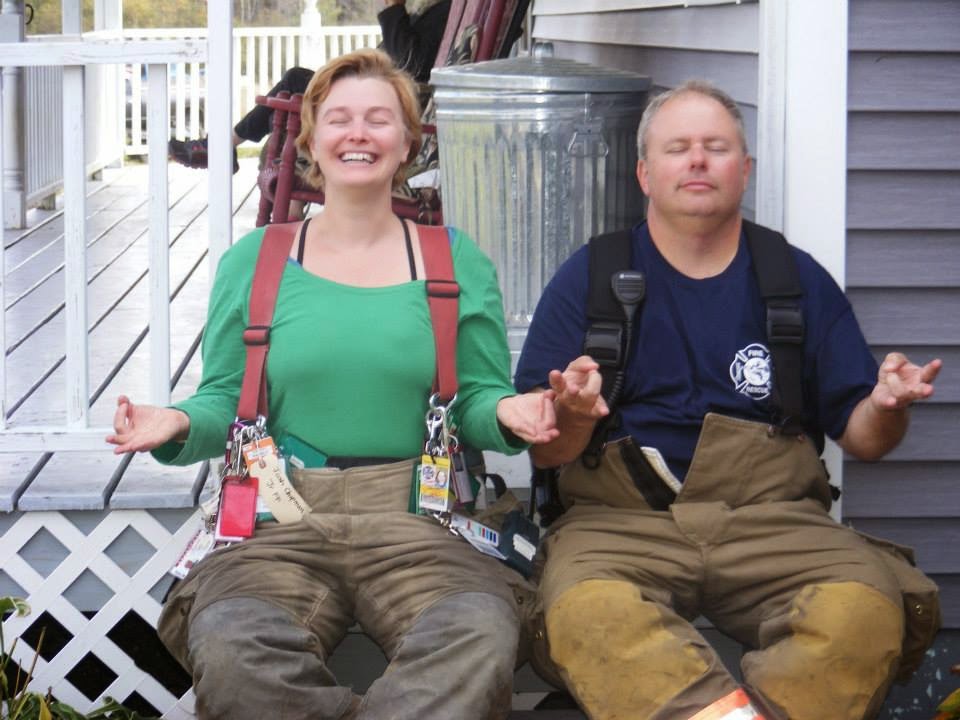
Friday, September 30, 2016

Fire Fighting Tales from Rural Maine: "When do we do anything alone?"

During our most recent training weekend at Fire Academy, we arrived before 7 a.m. and spent a long time standing in the cold as the cars were prepared for our extrication lesson. I was sick and I kept having to take off my gloves to blow my nose, exposing them to the well-below-freezing air. I was standing with a group of my classmates, fellow firefighters, and I was actually growing concerned about the intensity of the pain in my fingers and toes. I shifted and stamped and scrunched my fingers and toes trying to get them warm.
One of the firefighters noticed, and the next thing I knew, he was taking off his gloves and telling me to put my hands inside them. They were warm with moist heat and toasty! (Like the inside of a Ton Ton?!) And then another firefighter told me to give him my gloves and he put his warm fingers inside of them, so that when I gave back the first firefighter's gloves, my newly warmed fingers could go inside warm gloves. My hands stayed warm for the rest of the day. Neither of these men are in my company.
On the day when I got most beat up, the second day of our most grueling weekend, when my knees were bruised to the bone and the rest of me was smashed to bits and I was reeling from the trauma of having gotten trapped in a confined space (wedged between wall studs and tangled up so badly my helmet and mask slipped off while people screamed at me to go faster--twice!), and it wasn't even lunch time yet, I stumbled out of the building looking for all the world like what I was--a woman in shock and about to pass out--a firefighter spotted me and immediately asked if it would be okay if he helped me. He himself has two bum knees, but with respectful kindness he slipped an arm around me and helped steady my gait. We made it to the staging area and as I focused on keeping all the black spots in my vision from swarming together and dragging me down, he went for help. While he was gone and I swayed stubbornly on my hands and knees, refusing to pass out, but unable to do more than that, another firefighter noticed me and brought me water. And two minutes later, after I had been checked out and was back on my feet again, another firefighter offered to change my bottle for me. Again, none of those men were in my company, which means that they had no necessary obligation to notice or to care how I was--and yet they did; they noticed, they cared, they took swift and effective action on my behalf.
On Thursday night, Orland Fire responded in mutual aid to a fatal motor vehicle accident. So far two firefighters from my class have checked in on me, because we have been taught that is important to ask someone if they are okay after a night like that.
I had to do the confined spaces maze two times in one day on our second weekend at Academy. When it was time for the second trip through, I was so exhausted and overwhelmed and borderline hysterical with fear just at the thought of going blindfolded back into that terrible, relentlessly small space that I (embarrassingly) started crying--and not just a little. I was crumpled faced and sobbing. I could't stop; my defenses were broken and I was leaking fear. I didn't want to go back in. But my lead instructor told me, firmly, that if I didn't get back in there (NOW) then I wouldn't graduate. And I want to graduate...so I gathered what was left of my inner resolve, I climbed back into that dark maze and my lead instructor came behind me, barking at my heels.
The second time through was harder. I was more tired. More scared. My vision and breathing were more obstructed. I was carrying a heavy axe and had to sound the floor constantly as I crawled and felt my way through the tunnels and turns. They threw more unexpected and terrifying obstacles at me--snagged my bottle and held me down--and I completely lost my shit twice. Once I even begged to be let out.
But they didn't let me out. Eventually I stopped screaming and I overcame all the obstacles and I got myself out. But it was not pretty. And I assumed that I had failed. I was devastated.
That night I barely slept. I had night terrors about the maze all night, and shame and grief about my failure. At the end of the next day, I asked my lead instructor when I would have to try the maze again. Tears sprang to my eyes and my chest constricted in panic just to think of it. But I swallowed that fear, determined to graduate.
"You don't have to do it again," he said.
"But...I didn't do it...?" I said. I was very confused.
"You did do it," he said.
"But...but I cried? And I panicked," I said.
"You overcame some big fears yesterday," he said. "You're too hard on yourself."
"But...you mean I passed? I don't have to do it again?"
"That's right," he said. "You demonstrated adequate proficiency."
I was still very confused. "But...I didn't do it alone...?"
He looked me in my eyes and he asked, "When do we ever do anything alone?"
My eyes teared up again and I swallowed a little sob. "Never," I said. "We never do anything alone."
Beyond any of the hundreds of important skills we are learning--like how to tie a life safety knot or bail out of a burning building on a charged hose line or throw a ladder--it is these other moments that will stay with me forever. As much as I love knowing how to rescue someone down a ladder or how to tie a clove hitch or how to put water on a fire, of all the things I am learning about myself and being a firefighter, these lessons about what it really means to be a firefighter are the most profound.
As a volunteer firefighter in a very small, rural town, I will most likely never use most of what I am learning. I will probably never rescue an unconscious firefighter from a burning basement or be the one to deploy the roof ladder. And I expect after my end test I will promptly forget the names of all the different sprinkler heads.
On its face, of course, firefighting is about putting out fires. But at its heart, firefighting is about so much more than that. Our biggest promise is not that we will put out a fire, it is that Everyone Goes Home. And the only way we can accomplish that is to understand that we are, in each and every moment, from fatal car crashes to training exercises to explosive conflagrations...never doing anything alone.


Labels: , , , , , , , , , ,

Yoga Tales from Rural Maine: Bedtime

On Thursday night, I taught my first Yoga with Naomi bedtime yoga class to the inpatient kids at Acadia Hospital in Bangor. Acadia Hospital serves children and adults with mental health needs, and these children all live in the hospital. One of them had been there for three months.
None of the children were forced to come. They each chose on their own. There were six children, four girls and two boys. The youngest was four years old; the oldest were sixteen. Two of them were dressed in scrubs. One had an arm striped with cuts from wrist to elbow. One of them, the littlest, didn't want to take off his Batman flip-flops. I said that was okay. I said everything was okay.
For 45 minutes, these children had peace and kindness. They were brave and curious. Some were silent and big-eyed. Others tested the boundaries. Everything they did or said or asked for or felt during our time together was okay with me. Everything.
There was no other staff in the room. Just me and these kids. I met each challenge with softness, with sincerity. "I am here to help you keep yourself safe on your mat," I said. "You don't have to do anything you don't want to do. And I will do my best to notice if something doesn't seem right for you, but you are the only one who can really know if a movement or a moment is okay. Notice how you feel. And stop or change or ask for help if something doesn't feel right. That's your practice."
The most oppositional child, a nine-year-old girl, tall for her age, pushed back a lot. She complained about the brand of crayons; she expressed resistance, vocally and with her body throughout the first half of the class. And everything she did was okay. Everything. I met all of her resistance with warmth and kindness.
About half-way through, she began to soften. She interrupted my instruction to ask, "Do you know pretzel pose?"
"I don't think I know that one," I said. "Would you like to teach me?"
And she and another girl jumped up and taught me and the rest of the class "pretzel pose," which is a kids' version of Eagle Pose.
"Wonderful!" I said. "I love that one. Do you know any more?"
And they taught us two different kinds of pranayama (breathwork), which they know by other names.
"That's so good!," I said. "You know some beautiful yoga. Do you have another yoga teacher?"
"No," she said. "We learned in Coping Skills."
Yoga is being woven into the lives of these children at the hospital, not just by me, but by other practitioners; even when it is not called "yoga," yoga skills help kids (and all of us) to cope, to heal, to be.
Outside the room, other children were suffering. There was screeching, screaming, an interminable cry of anguish that went on and on and on and on.
But inside our room, it was more quiet and safe. It was peaceful and creative and fun.
"I'm here to help you feel peaceful at bedtime," I said.
"Bedtime is hard," said a nine-year-old boy. "Because that's when the bad things happened..."
My heart clenched. Bedtime is when the bad things happened. To this sweet, brave, bright, outgoing child. With painted fingernails and an endearing smile. The bad things happened at bedtime. And now he is here.
I took a deep breath. Breathing helps. But I never let my gaze leave his eyes. There are no words for a moment like that. So I made an instinctive, warm noise, a sort of compassionate hum. And I nodded. "I am here," I said. "I am here with you...would you like to make a bedtime wish?"
And he said, yes, he would. Everyone said yes, they would like to make a bedtime wish. I gave everyone a stuffed animal, a Beanie Baby, to hold--this little boy chose a ram because he enjoyed it's articulated legs. Each child also had two butterfly scarves to use during practice, and he wrapped his ram safely in one scarf, swaddling and snuggling it.
The kids got comfortable and safe on their mats. Gentle music played. I talked to them. And I moved around the room, inviting each child to close their eyes, to breath, and to focus on their wish. Then I spritzed "magic bedtime spray," (lavender water) around them (first asking permission each time) and then they opened their eyes and blew "pixie dust" out of my palm, to seal the wish, and then I sprinkled pixie dust on their resting bodies.
Every single child made a wish. Even the teenagers.
Before she left, the little girl who had been so oppositional in the beginning asked me, "Did I disrupt this group?"
"No, darling," I said, with full sincerity. "You were just right."
She smiled a big smile and glittering slightly from the pixie dust, she took away all the gifts I had given her: a picture to color, a brand new box of crayons, even the name tag she made for herself out of construction paper...and, I hope, the gift of a little more peace and safety at bedtime.

Labels: , , , , , , ,

Wednesday, June 10, 2015

Yoga Tales from Rural Maine: You've got to hug your farmer

Peter and I have a very small weekly food budget. It works out to be about $2.50 per person per meal for three meals a day, 7 days a week—and in weeks where there are very few yoga students, that budget drops even lower. There’s a direct connection between work and food for us, which is, by turns, equally stressful and beautiful. It grounds us, but it also often freaks me out. Finding creative, nutritious mostly vegan ways to feed us is a high-stakes adventure. Like everything in life, it’s a practice.
This spring/summer we have made the decision to dedicate 25% of our food money to fresh, local produce from our beloved local farmers. 20% of our weekly budget will go toward our CSA share in Lally Broch Farm, a compassionate and creative homestead doing really good work in the world. We had to pay in advance, which took some kerfoobling, but I made it happen because it matters; it matters in all sorts of ways. The other 5% will go to farm stand and farmers’ market purchases.
Yesterday, I got very panicky about my decision to write such a big check. What if the weather is poor and the farm’s crops fail? What if I’m too tired or too busy or too confused to find ways to prepare or store all of that beautiful perishable produce? In the past, my farm shares have often wound up being compost shares, because I had to compost so many things that wilted before I could figure out how to eat them. (What on earth does one do with celeriac? How much kale can one person really eat?)
But having taken a few years off from farm-sharing, I spent that time doing two vital things: healing my body and learning to cook. I’m still not 100% well, but I have enough energy and stamina to cook more often than not. And I’ve learned how to improvise with what I have in the kitchen. Armed with a salad spinner, a good knife, and my stick blender, I can make anything into a soup or a smoothie.
My hand shook as I took out my checkbook this morning to write my farm share check, but, like everything in life, eating well is a practice. Having faith in one’s ability to be healthy and strong and creative enough to cook is a practice. And if I know how to do anything, I know how to practice. This is what yoga teaches us. Don’t worry; just practice. So, I took a nice, deep breath. I let it out. I found my courage. And I wrote the check. Two and a half weeks of food money all at once, to one place. I made the commitment.
And I was rewarded by a visit from the kindest, most beautiful farmer you could ever imagine. She arrived as planned on my doorstep this morning, wearing striped tights (my favorite!) and beautiful jewelry she made herself out of eggshells (eggshells, I tell you!) and she handed me my pre-season delights: radishes, chives, fresh rosemary, thyme, & mint; beet greens and bok choy (I think); and a spring salad mix. All washed and neatly bagged and fairly broadcasting the loving energy with with they were planted and cultivated and cleaned and brought to me.
We stood there in the sunshine on this bright June day, both overjoyed. She thanked me for some kind things I had posted on Facebook, just when she needed them recently. Her eyes welled up with tears of happiness and gratitude. And when I opened my beautiful bag of greens and herbs, mine did, too. (She even threw in a welcome gift of lavender soap!)
I wanted to hug her, but I didn’t want to make her uncomfortable, so I said, “Are you a hugger?” And she embraced me in the warmest hug you could imagine and then she stepped back and smiled and said with jolly vibes and deep sincerity: “You’ve got to hug your farmer!”
Indeed, my friends, you really, really do.

My first pre-season delivery from Lally Broch Farm.

Labels: , , , , , , , , , , , , , , , ,

Monday, May 04, 2015

Tales from Rural Maine: Peace, fellow mammals

Yesterday, I worked with an animal communication client, a Dachsund in Florida who wasn't feeling well at all. His beloved human had made an appointment with me because she knew things weren't right and wanted to ask her dog how he was feeling.
I was able to tell her that, among other things, there was fluid in his lungs and that his heart felt congested and there was a sharp, nagging pain in his chest, in or around his heart.
She took him to the vet where the vet used her ears to identify what I had used my body to feel; there was fluid around the heart and lungs. She took xrays, which revealed the other things I had described in our session and they decided on a course of treatment.
My work as an animal communicator never--ever--replaces proper veterinary care. I can't diagnose any condition or recommend treatment. But what I can do is help to efficiently locate sources of pain or illness. I can also communicate directly with companion animals so that questions like, "How do you feel?" "What do you need?" and "Is there anything you will eat?" can get answered. Those of us who have gone through illness and aging and end-of-life decisions with our beloved pets know what a blessing it can be to have answers to these questions.
Yesterday, for instance, we were able to find something this sick dog was willing to eat, so that while we were on the phone, he ate for the first time that day, which was a relief to both human and animal.
Animal communication is telepathic work. It happens over time and space, so location is not an issue. If you have a phone and you speak English, we can work together.
And it's one way that we can offer comfort to both animals and their humans in moments of crisis. One of the most difficult and beautiful things I do is to stand calmly in the moments of profound suffering when it's time to ask an animal if they want help out of their body. I can be there for you in this, and it helps.
If your reaction to this story is "bah humbug" or "she's nuts," that's okay. You don't have to work with me. But if you feel open to the possibility that maybe I can help you and your pet(s) to communicate, about health, behavior, transitions, or anything at all, I encourage you to get in touch. We can even talk to animals who have already passed on. Peace, fellow mammals!
Learn more at my website, http://www.peacefellowmmammals.com

With my niece and a tiny mammal we hoped to adopt from Peace Ridge Animal Sanctuary.

Labels: , , , , , , , , ,

Saturday, May 02, 2015

Yoga Tales from Rural Maine: Double Yoga Thursday

In the "bad news" column: I have a migraine on Double Yoga Thursday.
In the "good news" column: In my first class, I felt like I didn't serve my students with as much potency, grace, or presence today, what with the invisible axe that was lodged in my brain matter and the near-fainting spell that caused me to bring us all down to the floor--and quick!--so teacher would not be found unconscious. 
But, despite my own internal sense of not being a graceful teacher today, after class, one of the students who's never said anything in particular about how the class feels to him, sat for a long time observing his shoe after class, without putting it on, a look of peaceful contemplation on his bespectacled face. His shoe was here; he was elsewhere. 
He turned his sweet face up to me when I walked by, and he said, with a far-away look and a tender smile, "You...are a poet..." and he held his forgotten shoe and smiled at me, eyes sparkling; his smile was so profound that it seemed to come not only just from his lips or even his face; it felt like even that one stockinged foot was smiling up at me. "You are a poetess...," he said and sort of trailed off, still smiling, still looking in my eyes, unable to really find more words to express how he was feeling.
What remarkable good fortune it is, to feel like a grenade has gone off in one's brain and to still receive that level of grace from a student.
I have the best job in the world.


Holding up the sun in Costa Rica.

Labels: , , , , , , , ,

Monday, May 19, 2014

The letter


From: Naomi Graychase <graychase@gmail.com>

Subject: Happy Anniversary

Date: May 23, 2007 2:00:03 PM EDT

My Dearest Classmates,

[I tried to send this note to you yesterday, but a glitch in the e-mail broadcast system prevented it from making it to you. C'est la vie.]

On this day, thirteen years ago, we stood in the blazing sun in black robes and white dresses (or pants suits) and sweated our knockers off while we waited to receive the hard-won diplomas of people who were not us. Then, when all the speeches were over and all the names had been called, we marched, dazedly, onto the grass in front of King and Scales, formed a spiraling circle, and passed our diplomas until we came up with our own.

It was the best of times, it was the worst of times. The next day remains in the Top Ten All-Time Worst Days Ever for me. I hope it does for you, as well. That would mean that you still love and miss one another, and also that your life hasn't really been that bad since you stopped singing gaudeamus igitur twice a year and eating Fisherperson's Platter.

Spring has been cold and slow to come fully into herself this season in Northampton. Ivy Day was chilly and rainy. But nevertheless, last weekend, the town was swarmed with women in white, with name tags and tote bags, and the wistful, determined expressions of people who have returned to a place that will always be familiar and yet somehow never be the same, people who have journeyed through time (and airports) to invite their past to meet their future...people who are trying to find a way to squeeze in one more trip to Herrell's before they catch their shuttle back to Bradley.

I hope that these thirteen years have treated you well; that what you learned at Smith, whether it was to remain open-minded when encountering the unfamiliar--such as grapes paired with brown sugar and sour cream for dessert--or to speak up and think hard about what you believe in, has stayed with you and helped you through every victory and every loss.

We never read in the pages of the Alumnae Quarterly about the other kinds of successes in our lives, the brave and beautiful ways we get ourselves through the bankruptcies, miscarriages, divorces, lay-offs, betrayals, illnesses, and the other ugly struggles that come to all of us eventually. I think that's sort of a shame. I consider these things to be the true successes in life; the moments when we rise up amidst adversity and make brave choices and fight our way through. That's the stuff I really wish we were sharing--not that promotions and vacations and babies aren't fantastic; I love hearing about them. But I'd also love to know more about the creative, enlightened ways that each of you has managed to navigate what has been difficult in your lives. How you got sober or recovered when your business failed or found the courage to drop out of medical school and disappoint your parents or leave your spouse or care for your sick mother or whatever it is that you've done bravely these last thirteen years.

Since we don't currently have a forum for exchanging those stories and ideas, I want to take a moment here, on the 22nd of May, 2007, to pause and to acknowledge that for every one of us who has earned her PhD or published six books or married a dreamboat or landed her dream job or bought her dream home or given birth to brilliant children, there are a lot more of us who got a little lost along the way; who made difficult choices between career and family; who quietly left marriages that weren't working or jobs that weren't right; who lost children, or couldn't have them, or had children who were sick. Some of us fled our homes when Hurricane Katrina hit, some of us fled for other reasons, and some of us are still searching for something that really feels like home. Some of us are sick and some of us are nursing spouses or children or parents who are fighting illnesses they may not defeat. And the courage, intelligence, compassion, and strength that these things take are worth applauding.

I hope that all of you are thriving and happy and healthy, but for those of you who aren't--don't let the Quarterly (or anything else) fool you. You are not alone. Whether you are plagued by ambivalence or something easier to diagnose, there is someone among us who is struggling like you.

In the diploma circle it took more time for some of us to find what we had earned than it did for others. If you are feeling lost, I hope you will hang in there, stay on your feet and keep passing to the right (as it were), and yours will come eventually. And if you are one of the ones that have already found the metaphorical diploma with your name on it, I hope you are whooping with delight and throwing your cap up in the air tonight.

Happy Anniversary.
xxoo
Naomi

Labels: , , , , , ,

Monday, April 07, 2014

Yoga Tales from Rural Maine: Bridge the gap

Yesterday, I faced two big fears: bridges and running. This was a big deal on both fronts. There is one bridge, in particular, that scares the bejeezus out of me; the Penobscot Narrows Bridge, which spans the Penobscot River between Prospect and Verona Island in the bay of my home town. I don’t even like to drive across this bridge. I avoid it like…well, like a bridge. I refer to it as “The Bridge of Death,” and not because so many people have jumped off it. It—and its predecessor, the Waldo-Hancock Bridge—have always filled me with a deep sense of deadly, deadly foreboding. I would no sooner walk (or run) across that bridge than I would volunteer to be buried alive.

Image courtesy of Bangor Daily News


And the running…why fear running? Especially someone like me, who was a multi-season All-State athlete, who loves to train, to compete, to run and to play—why fear a run? There are two reasons. The first is a fear based on past injuries. It’s a sort of nameless, generalized fear. I’m not sure I specifically fear another injury, or fear that I’ll aggravate an old one; although maybe that’s it. It’s hard to say, exactly, but the thought of road races—something I used to enjoy—triggers a feeling of panic and dread. My psyche does not want to experience the things I’ve gone through, with injuries, again.

I have injured my right knee severely, twice. The first time in 1999 while training for the San Francisco marathon. I tore something in the tenth mile of a twelve-mile training run just two weeks before the race. I finished all twelve miles of the run, limping through the last two, and I wound up having surgery instead of running the marathon. The rehab was long and painful and I never fully recovered the strength or muscle-mass in that leg.

The second injury, to the same knee, was even more severe. In 2007, I was in the best shape I’d been in since the marathon training injury in 1999, and then one horrible afternoon in June, I slipped on wet paint during a backyard volleyball game—the last point of the day!—and severed my ACL. In one horrible twist, that ligament was ripped fully off my femur, and I hit the ground with so much impact, I bruised the bone.

For eight months I was in terrible pain, and all alone in that pain. No comfort, no assistance, no support. The first few weeks were a struggle to survive, as I couldn’t drive, my knee was swollen like a grapefruit, I was in terrible pain, and there was no one to help me do simple things, like get food or do dishes or get the laundry up and down two flights of stairs. I remember asking an old friend if she could spare half an hour to help me one day and she said, “No.” She had to study for her bar exam. Everyone I asked was usually too busy and I sank into a deep and desperate despair and gave up asking. While I know that things are different now—I have Peter, friends and family, who would help me--the experience of being utterly destitute, living in a constant level 8-to-9 pain, and being so very hungry, are scars on my psyche that may never heal. To run a race, I have to face all of that deeply ingrained life-threatening terror.

I didn’t have reconstructive surgery after the ACL tear because I have a non-ACL-dependent knee, it turns out. The orthopedic surgeon said my right knee was as stable as it could be, under the circumstances, and surgery would not improve it. I did a lot of painful, grueling rehab, but since that day almost seven years ago, when my ACL snapped, I have been afraid to run or play any sports. I lost a huge part of myself that year.

I have always been a person who enjoyed sports and running very much. Tennis? Volleyball? Football? Count me in! I am an athlete. In the same way I am a woman, a Smithie, an American—“athlete” is inextricable from who I am. I’ve never been the greatest at endurance, but when I injured my knee the first time, I was doing well; a six-mile run was an easy day. I was never the fastest distance runner; a ten-minute-mile training pace for anything over 5K was about the best I could do. But I loved it.

All through my twenties, I was still playing in recreational volleyball, basketball and elite soccer leagues in Northampton or San Francisco. But since 2007, I have felt afraid. My knee often hurts and feels unstable. It makes bad noises and it just doesn’t feel safe to do anything with quick stops, starts, or pivots—or anything that requires pounding the pavement.

And, worse than that, there is a second aspect to my fear of running. This fear is dark, specific, and rational. Ever since 2007, I have been unable to recover from exertion.

You may think that’s an overstatement; or perhaps it’s a statement that just confuses you. How can a person not recover from exertion? If you think either of these things, it’s because your body does it for you without you having to think about it. My body no longer does.

I injured my knee in June of 2007. That same month my truck (to which I had a deep emotional attachment) died, my beloved cat Calvin died at the age of 12, and I turned 35. I was suffering terrible physical and emotional pain, and was completely alone, as well as financially strapped. I worked very hard to keep myself alive, to heal, but I wasn’t doing well. In August, I saw a psychiatrist about my depression and he put me on a very small dose of Prozac. Over the next three weeks, I gained 30 pounds without changing diet or exercise. The depression did not lift, but I gained 16 inches on my waist and three cup sizes in my bra. And I became unable to recover from exertion.

I went back to the psychiatrist who took me off the Prozac, but none of my symptoms improved. I have spent the last seven years seeing doctor after doctor, specialist after specialist looking for answers. Most of them told me to exercise more and eat less. When I told them I was already on a low-calorie diet and that I couldn’t exercise because it made me sick, they didn’t believe me.

“You are constitutionally flawed,” said the prestigious endocrinologist I’d waited months to see. “There is nothing western medicine can do for you.” He didn’t do a single blood test. No lab work. Just looked at me, listened to my heart and my lungs, asked me about my medical history (starting from the day I was born) and then rendered his verdict.

I once told a friend that I was frustrated because exercising made me sick. “It’s like I’m allergic to exercise,” I confided to her.

She laughed. “I know, right? Nobody likes exercise.”

“No,” I said. “My body actually does get sick. It’s like I have the flu.”

She winked. “Exercise makes me sick, too.” No one seemed to understand.

I got a similar reaction from almost all of the doctors and nurses I saw. I couldn’t make them understand.

“Listen,” I would say. “If I go run—at this point, if I even go for a gentle 20-minute walk—I can do it. I can rally and find the energy and I can do that. Sometimes I can even do it for two or three days in a row. But then, I will get flu-like symptoms that are unbearable. I will have body aches, headaches, runny nose, sore throat, sneezing, coughing, and the most incredible weakness and fatigue you can imagine. I can barely move.”

I told this, over and over, to doctors and nurses and nearly every one of them told me to exercise more and eat less, or that I was just getting older. Some of them put me on birth control pills, which only made me sicker.

By 2009, I was so sick that during the end of my monthly cycle each month, I was too weak to walk or stand. I relied on a wheelchair if I had to do anything more than just a few minutes of walking. I was miserable, weak, clinically obese (having not yet been able to lose those 30 pounds), and every single time I tried to return to my loves—hiking, walking, running, biking, working out—my body would collapse. If I hiked for an hour one day, I would feel like I had the flu for the next three weeks. One hour of hiking would cost me three weeks of my life. It was a high price to pay. For those three weeks, I would barely be able to cope with daily tasks; eating, sleeping, brushing teeth were almost all I could manage.

So when I decided to run across that bridge yesterday, as part of the Bridge the Gap race, I was not only facing my fear of that (terrible) bridge and the nearly uncontrollable urge I have to fling myself off it every time I’m on it (not from suicidality, just because that’s what happens to me with heights), I was also facing my fear of losing the next three weeks of my life. I was facing my fear of collapse and embarrassment. I was facing my fear that I am old, constitutionally flawed, and will never be able to run again.


I set the goal to run that race—just the Fun Run, the first mile across the bridge, not the 5K or the 10-mile—the year before. I began training in October, running diligently every single day on my elliptical machine. I started gently, very gently, running five minutes each day, slow and easy. And I was overjoyed that I was okay! No flu! No symptoms. I could do five minutes a day—about 6/10 of a mile—and be fine. I was overjoyed.

This small bit of daily running was possible because in 2013, I finally found a nurse practitioner who believed me. She not only believed me, she immediately recognized my symptoms and knew what to do. While it has been expensive and hard work, and while I still have a long way to go, for me, in this particular body, at this time in my life, the ability to run five gentle minutes a day, every day--it was like summiting Everest. I loved it. I gave exuberant reports to my nurse practitioner and to Peter. It was exciting.

In November, I moved up to six minutes a day—7/10 of a mile. In December, seven minutes a day, 8/10 of a mile. January, eight minutes a day, 9/10 of a mile. I was doing great, and I was on target to be able to run the mile-long race over the bridge in April. This was happening!

One of the things I have done with my improved health and wellness is to join a volunteer fire department. It is remarkable that since 2011, I have gone from wheel-chair-dependent to yoga teacher and firefighter—and I had set my sights on being a runner again, an athlete who could do things.


Every now and then, I would look at my situation and feel embarrassed and demoralized. Who has to train with this much devotion and dedication to run one mile? But the key to my recovery has been, in part, a compassionate approach to understanding the biomechanics of my system. An essential part of my healing has to be compassion; anything else only stresses my system and actually makes the problem worse. Being ashamed of my size, my limitations—this only increases my size and my limitations. Shame does not serve me.

What I understand now, thanks to the insights of my wise young nurse practitioner and the very helpful book Are You Tired and Wired? (Marcelle Pick), is that I am not “constitutionally flawed.” My body had a very natural, very understandable, very treatable reaction to prolonged, unremitting stress. I have endured so much stress and trauma in my life, right from the very beginning, that by 2007, I was poised for collapse. It’s really a miracle that I made it that far. With all of the intense physical and emotional stressors that exploded that summer, and the addition of the Prozac, my system “flatlined,” as Pick would say. I demonstrated all of the classic symptoms.

In August of 2013, I took a diagnostic quiz (Are You Tired and Wired? pp 57-58). A score of 26 or more would have indicated that I was suffering from severe adrenal dysfunction. My score was 83. Why had no other doctors put this together before?

I decided I couldn’t think about that question.

“Aren’t you angry?” my sister-in-law asked one day, as I shared with her what I’d learned and how much it was helping me. And I realized, I wasn’t. I was too grateful for what was happening now to think about all the ways in which those other practitioners failed—and even harmed—me.

This run across the bridge was going to mean something big. It was going to mean that I could be well. It was going to mean that if I am slow and steady and faithful, I will, perhaps, one day be a person who can go jogging, bike-riding, hiking again. It represented my commitment to rise up out of helplessness, fatigue, and despair, and cross that bridge to wellness.

My future felt bright and I felt elated each month when I added another minute to my daily run and remained without side effects. But then, on January 6th, I had an accident during firefighter training. I suffered a concussion and a severe neck sprain with repercussions for not only my cervical spine, but my thoracic spine and shoulders. The blow was so hard and at such an angle that the damage was extensive.

The next three months were a nightmare of pain, sadness, brain fog, and isolation. There were many aspects of the injury and the worker’s comp bureaucracy attached to it, which were unbearable. Not only did I no longer have access to firefighting, I also did not have access to yoga, to my students. I couldn’t teach or practice. And I couldn’t do my daily run.

The Bridge the Gap race I had set my sights on was going to come, and it looked like I was not going to be able to do it. And yet…a few weeks prior to the race, I was finally cleared by my doctor to return to full-duty with the fire department on a trial basis. My physical therapist encouraged me to resume normal activity and see how it felt. I was afraid to climb back onto my elliptical machine. Afraid to face the inevitable losses; afraid to experience how winded, and weak and tired I’d be; afraid of the potential return of the flu-like side affects; I was afraid to begin losing days again.


During the worst days of my injury, in January, my concussion combined with my migraine disorder, made it impossible for me to think. Literally, if I formed thoughts or if I used my eyes to watch TV or read or even look out the window, it would trigger cascading migraines, blinding, searing, indescribable migraines. The only thing I could do was to lie in restorative yoga postures, close my eyes, and listen. Listening would keep my mind from forming thoughts. Music made me too emotional, so I listened to stories. Story after story after story. Whatever I could get my hands on. I even listened to James Earl Jones read the bible. (There sure is a lot of “begetting” in that book.)

My brain injury, combined with the loss of income, the loss of almost everything I held dear, the heartless and crazy-making bureaucracy of worker’s compensation, and the pain--good God, the pain…it was too much. I was struggling, all day, every day. And then one day, I had a thought. It was like a key clicking into a lock. “Kill myself.” I felt a wave of relief. The world felt so simple, so clear. I can’t accurately describe the rightness of this thought. Nothing in my whole life had ever felt so purely correct, so absolutely, perfectly right as that thought. If we had had a handgun in the house, I’m certain I would no longer be here. For some reason, it had to be a gun, in this thought. It was so simple, like opening a door if you wanted to go outside. Why wouldn’t you?

Because my gun is a .22 rifle, it wouldn’t do the job. My mind then went to the bridge, as a second thought. Without a brain injury, and without the exacerbating forces of the nightmarish experience of trying to work through a worker’s comp claim—a process my occupational medicine doctor describes as “uniquely adversarial,” and which, according to him, drives everyone (100% of his patients who have to deal with it for more than three weeks) into a deep, unrelenting depression, so much so that he asks everyone to take a sanity questionnaire when they visit and he keeps referral cards for suicide hotlines in his office—without those things, I would not have had that thought. I’m certain of it. It wasn’t like me.

I know for certain that were I to have had a suicidal thought, without the influence of the brain injury or the inhumanity of the worker’s comp maze, I would have thought of gas or pills or something really gentle. I am not a girl who would shoot anyone—or anything—especially myself; and I am not a girl who would willingly step foot on a bridge if there were any other alternative. The fact that guns and bridges felt right to me shows, even more than the suicidality, that something in my brain was absolutely not functioning normally. Without a properly functioning brain, we are at the mercy of thoughts we have no way to control.

So it was the lack of a pistol in my home, more than anything else, that saved me from dying that day; and it was my experience as a first-responder, looking for the body of a man who had jumped from that bridge, that kept me from jumping that day myself. My misfiring brain was, thank goodness, able to at least put these thoughts together. First, that my gun couldn’t get the job done, so don’t try; and second, I could remember the experience of being out on the water looking for a body; I knew what that was like, and because of that and only that—the thought that I couldn’t possibly ask Bobby or Julia or John or Casey or Dave to go out into the bay to recover my body—I lived. My malfunctioning brain was able to find those two logical thoughts within its buggy programming, and it saved me: “The gun won’t work" and, "You can’t hurt your first-responders; you love them.”


Once I’d made it past that thought, which took about 18 hours, it was like putting on a new skin. I shed my injured, crazy skin, the one that had been created on the day my skull rammed into that fire truck, and I stepped forward, lighter, more peaceful, and aware that I needed to meditate—and pray—if I were going to hold myself together. I would stop fighting for anything from worker's comp. I would pay my own way. None of this was worth dying for. It became a life-and-death battle and I wanted to make certain that my brain knew to choose "life."

Eventually, I developed a new daily practice, of meditation, mantra, and prayer, and I have done this without fail. In the same way that I ran every day before I was injured, I have come to my meditation, mantra and prayer each day with devotion.

And it was this—more than anything—that got me to the bridge yesterday. I was afraid to face the place where my friend’s sister had jumped, just a few days after I decided not to; I was afraid to face the place where I almost jumped. I was afraid of hurting my knee. I was very afraid of collapsing half-way across and suffering the humiliation of publicly demonstrating that I could not run a mile. And I was afraid of losing weeks of my life to the recovery process, even if I did make it across.

But here’s something else I’ve learned from yoga and volunteering as a firefighter: I can do it. It doesn't matter what it is; if I decide to do it, I can do it. I can do 108 Sun Salutations, if I set my mind to it. I can stand on my feet for hours at a training or a fire scene, knowing it will take days or weeks to recover, that my knee will swell and my body will ache, and I can do it. I can even smile while I’m doing it. And I can go out, in the cold and the rain in a tiny little boat and look for a body under the bridge, even though every single one of those things terrifies me. I know this about myself. I know it so deeply that even when I was lost in the confusion of a battered brain, I accessed that knowledge.


When I meditate, I meet myself in the place inside myself where I know I’m okay. I know how to get to that place because I have worn a steady path to it, day by day by day. I know how to be confident in my ability to get things done, difficult things, and I know how to breathe. Thanks to my meditation and yoga practice, when I decided to run yesterday, all the buzzing fear stayed out around the edges, and the only thing that existed was the here and the now, this breath, this footstep, this moment, this me.

And that’s how I ran the race, the same way I meditate. Inhale, count to four, exhale, count to four. I just did that, over and over and over. I kept my eyes straight ahead, I put one foot in front of the other--and I let myself be loved. My friends, my students, had come to be with me in this. They ran with me, on either side and behind, and one was waiting at the finish line. And so, I was transported, across the Bridge of Death, one footstep, one breath, (one silently uttered curse), at a time, until I was on the other side.

I often tell my students, we can get through anything—get over or under or beyond anything—if we do it one breath at a time. We can bridge any gap this way, if we are kind to ourselves, if we are devoted, and if we have the courage to try.

Post Script: I was among the last to cross the bridge yesterday, having been outrun by at least a dozen small children, but it didn’t matter at all that I was nearly last. I have never been the sort of athlete who needs to win. I love winning, don’t get me wrong, but what I love most of all, is excellence; I love doing my best, and that is what I did yesterday. My best is measured only against myself.

It was important to me to prove to myself that I had the heart to do this without stopping. No matter how much my body screamed in protest, I wanted my willpower to keep me going. And it did. My body was not in good enough shape for that run, but I made it do it anyway, and for an athlete, that is a victory.

For a person recovering from severe adrenal fatigue, unfortunately, it is not a victory; it’s a setback. Within ten minutes of finishing the race, my body’s immune response was bull-blown. My nose was running like someone had turned on the tap. I was sneezing incessantly. I drove myself home, drank water, took homeopathic remedies. My eyes and throat itched, my sinuses tingled non-stop, as though I’d just sniffed pepper. I had lots of energy and enthusiasm for about an hour, but then the collapse took hold. By the time Peter came home from work three hours later, I was in bed, too weak to move. Face raw, already, from hundreds of nose-blows. My head was stuffy, my chest was burning, my voice was nasal and scratchy, and I was so weak I could barely lift my head.

I had taken a Claritin the night before. I took two Benadryl when the allergy-like symptoms began to peak. It didn't really help. Peter fed me. And I kept drinking water and taking homeopathics. I was glad I had triumphed over the bridge, but so incredibly sad that my body was collapsing. I lost all of Sunday. I took more Benadryl at bedtime, along with a Flexoril, and I turned off my emergency dispatch pager. I would be no good to anyone at a scene, and I needed my rest.

I woke up this morning and my eyes were almost swollen shut. They were not infected, just reacting as if they had encountered an allergen. They remained dry, itchy and slightly swollen most of the day. My throat hurts. My nose runs. I’m tired and sneezy and my lungs burn. I am weak. Too weak, I think, to go to my firefighter training tonight, and this makes me incredibly sad. I want to put on my turnout gear and learn about fire extinguishers. But...I can't. It is the sadness I feel, even more than the physical symptoms, that makes the experience of being in this body hard. Whenever I do one thing—like run a race—and then I have to pay a heavy price, like losing every other activity for days, I feel the loss keenly. It is one of the things I was afraid of when I thought of running across that bridge. And...it happened.

It was neither kind nor gentle of me to run that race when I knew my body couldn’t take it. I was sad and humiliated as my friends rejoiced on Facebook about our run, and asked if I wanted to run a 5K next month. They, of course, have no idea what that race cost me, and how ill-equipped I am to run a 5K right now--or how badly I want to be able to. Feeling ashamed about this is counterproductive; and yet, I do. There is a level of self-acceptance that I have still not reached. I still see myself as able-bodied and athletic, and every single time I realize I am not, I grieve all over again.

My work today—and every day, even after I am finally well—is to practice self-acceptance. To practice lovingkindness, to my Self. To allow myself that grief, for what is lost when I feel it, but also to connect with the joy of what is. To let that grief be water under the bridge, and to be with the joy of acknowledging that I was brave, I was well-supported by loving friends, and ultimately, the joy of being able to run across that frigging bridge—because I did make it! I did run that mile without stopping. I could not have done that at any other point in the last seven years. Flawed as it still is, this is progress.

My “Bridge the Gap” race my have been slow, and it may have been a little too much for my physical body right now, but the fact that I did it proves that this combination of yoga, meditation, prayer, the care of a good nurse practitioner, and volunteering as a firefighter have given me the tools I need to bridge the gap between illness and wellness. It also proves I have a long way to go. I intend to get there, one little breath, one giant bridge, at a time.

Labels: , , , , , , , , , , , , , , ,

Friday, January 31, 2014

Yoga Tales from Rural Maine: My cup runneth over

Every Thursday, from 1-2 pm, I teach a gentle, healing yoga class at the Beth C. Wright Cancer Resource Center in Ellsworth. My students are mostly cancer patients and cancer survivors. They have busy lives and a lot on their minds.

I had to cancel class this week, because of an injury I sustained during firefighter training. It was a difficult choice, but the right thing to do.

Today in the mail I received a beautiful hand-painted, hand-written card from one of my Beth Wright students. She sat down yesterday, at the time when we would normally be together, and wrote me the most beautiful message of loving appreciation and healing wishes. Then she put it in the mail, so that I would get it today.

I was deeply moved by her thoughtfulness and by the awareness of the impact we have on one another, teacher and students, because of this gentle, healing time we spend together each week.

Another of my other Beth Wright students hand-knit me a gorgeous cowl neck warmer, which you can see in the picture I posted yesterday of me and Marjorie. She wrapped it in the most beautiful paper and slipped it into my bag after last week's class, with an inspiring note of kindness and appreciation.

I have been wearing that cowl every day, and since the worst part of my injury is my neck sprain, it has felt very good to be warmed by her gift, both in body and in spirit.

The downside of being sidelined by this injury is that I have lived inside a cylinder of constant pain for the last three weeks and the things I love to do most (yoga and firefighting) have been taken from me; the upside is that being honest about my pain with my students has given them the opportunity to pour a tremendous amount of genuine lovingkindness into my heart. I was not expecting it. My cup runneth over.

Labels: , , , , ,

Sunday, January 12, 2014

Yoga Tales from Rural Maine: Why resting matters


On January 6th, I misjudged the clearance above my head and jumped—hard—in order to adjust my footing while standing on the steps of a fire truck during what should have been a painless firefighter training. Instead, I gave myself a concussion and a neck sprain and developed a killer migraine. That was a week ago.

One of the most fascinating but challenging aspects of my brain injury has been around my relationship to words. I am a person who is naturally able to quickly locate and articulate the words for the ideas I have and want to convey to a listener or reader. But since my concussion, I have had a fierce struggle to connect these dots. It sometimes takes a lot of time and mental energy.

When I was filling out forms about my accident, for instance, I could write the number of my street address with no problem, but I couldn't retrieve the word for the name of my street. I could understand that the box labeled Street wanted the name of the street where I lived. I knew what my home looked like; I could picture it in my mind. I could feel the feeling of home. But it took all of my determination and focus to pull the word "Central" out of the vast, foggy canyon of mental space behind my eyes. I also struggled for a long time looking for the word "Bucksport." I nearly wrote "Northampton," a town where I used to live. I started to draw the "N," but an alarm bell went off and my sluggish mental engine chugged away until I could retrieve “Bucksport” instead. It took at least three times as long as it would normally have taken to fill out that simple form and it made my head feel like it was splitting. That was about 36 hours after the concussion.

Today, my sister-in-law asked me to write down the ingredients for the smoothie I had made her. I was able to speak all the right words to her. I found “Yes” and “I’d be happy to,” for instance. I was able to understand the task and to remember where I kept pen and paper. But when it came time to write down the simple list of ingredients, I had to fight really hard. My brain felt so tired. I had to push; it actually felt like it took muscular effort. And with all that hard work…I still got it wrong.

Trying to locate the words and then write them down was so challenging that I used a work-around. Since my visual memory is still very sharp, I tried understanding the letters as shapes. I wanted to write “coconut milk.” I wasn’t able to write the words as words, per se, but I could picture the word and then copy the shapes onto the paper. This is a different mental process than spelling, I think.

I could picture the container. I could remember the taste. I knew I had added something called “coconut milk” to the smoothie. And I could say the word. But when I tried to turn that knowledge into a written item on a list…the letters c-o-c-o-n-u-t…they were…foreign. They floated and separated; they had no meaning as a sum total, strung together. It was confusing. “I know I should know this…,” I thought. It was a puzzler.

When I finally wrote the words, it felt more like putting the right-shaped pieces into the right-shaped hole, like when you were a kid and you had that toy? The plastic box and you had to put the star in the star-shaped hole and the crescent moon in the crescent moon-shaped hole…?

I’ve always been a good speller. I’ve always learned and retained vocabulary well. I’m a writer. Words, stories—this is how I interact with my universe. It is so…curious to realize that this complex process happens underneath all that. These complicated tasks are always happening, it’s just that usually my brain does them lightning quick, so it seems like they aren't there.

In the end, what I wrote on the list was “coconut millk.” I could see that it was wrong, but the migraine-type headache I’ve had since about 24 hours after I cracked my head was made worse from the effort; my brain felt what I can only describe as muscle fatigue. I decided it was way too much work to try spelling the word “milk” again—plus, I wasn’t confident I could get “coconut” twice, anyway, if I started over--so I just told my sister-in-law, with my voice, that I was having trouble with spelling, but that she knew what I meant.

Why can I say “coconut milk,” but not spell it? Why is that so hard? I suppose a neurologist could explain.

The important thing, I think, is that I’m not worried. I trust that my words will come back. I wrote “gap” the other day when I meant “lapse,” and it took me more than 24 hours to resolve the nagging feeling that "gap" wasn't what I'd meant to write and to locate the right word to take its place. Words are getting mixed up for me. But I know that won’t happen forever.

Until I get all better, I am using my restorative therapeutic yoga training to help me to cope and to heal. My doctor told me that the key to recovering fully is to rest the brain. He mentioned a recent study that showed (if I’m recalling correctly) that in a group of American teenagers who had received concussions, half were allowed to play video games while recovering and half were not. In the group that played video games, 70% of them (if I remember correctly) suffered more symptoms and slower recovery times. Luckily, I don’t play video games. “It turns out,” said my doctor, “that the brain is like a muscle. If you injure it, you have to really rest it. If you keep using it and using it, then it takes longer to recover and repair itself.”

This makes sense to me. I also read an article from the Mayo Clinic online that said watching TV was detrimental to concussion recovery because it required the brain to focus. So I have tried to rest my brain as much as possible—and this is remarkably hard. Watching movies or good TV programs is how I would normally “rest.” I haven’t cut out that sort of resting altogether, but I have spent a lot of hours lying in the darkness in restorative yoga postures with an eye pillow over my eyes. My migraine and neck sprain have been extremely painful, so it was a challenge to just…be. It is not easy to lie still in the quiet with nothing to distract me from the pain.

Sometimes, though, it is beautiful. This is what I wrote in my journal on Day Three of the pain: The thing that made me feel better was lying with an eye pillow and listening to TV or just being in the dark; it was shockingly hard to rest my brain; to let it do nothing—and to rest my body, too; stillness, closed eyes, rest; in the warmth and darkness alone with the fire and the cats, I rested and I visited with my pain; it cringed and withdrew from hugs or any touching; it flinched with cool or heat; the only thing that did not make it feel worse was quiet companionship; bare as bone, raw, solid, aching arch of pain and I sat next to it, with love, and we watched together, not touching; as the horizon blazed red, then orange, then yellow and then a radiant white Light, then twinkling darkness. Touching, attempting to “help” or control—these upset my Pain, intensified, prolonged, made worse her experience. I breathed; I stayed. I watched and waited; I feel blessed and peaceful; our home is miraculously, effortlessly warm; thank you; I am loved and well-supported by my partner—thank you; I saw a kind and helpful doctor; I saw Vicky, who is pure love itself; I have something for the migraine and Tylenol for the pain; I have a day to rest tomorrow; all is well; my head and neck sure are full of pain, but all is well. Thank you.

I suppose I share all of this because I’m not sure, culturally, that we are really prepared to rest—or to be with our pain with awareness and compassion. I don’t think we, as Americans, really understand what rest is. We watch TV or fiddle around on Facebook and we think we are resting…but I know for a fact that our brains are not at rest when they do these things. I know because of how much it hurts my head to check Facebook or watch TV.

Meditation is the act of Being. It’s that simple. I spend a little time doing this almost every day. But because of my injury, I have had a glimpse into just how lopsided even my life is—and I’m a yoga teacher! We need more eyes-closed quiet. We need time to recover from mental fatigue. It’s a real thing--even if we aren’t foolish enough to bonk our heads on a firetruck! I understand now how Deepak Chopra can spend two hours every day in meditation. I’m beginning to wonder how any of us survive if we don’t spend two hours every day in meditation…

Today is the first day that my pain is trending downward. While I’m still struggling to write grocery lists—and writing this post has ramped up my pain quite a bit and my right arm has gone all tingly—I’m encouraged to have (I hope) finally turned a corner so that I can go back to living without the feeling that my head is cracking open and my neck will never stop aching. If I continue to truly rest as much as possible, I expect that I will soon be writing grocery lists with all the speed and acuity of a woman can not only spell “acuity,” but who takes such things for granted.


Labels: , , , , , , , , ,

Friday, August 30, 2013

Yoga tales from rural Maine: A heart so full of love

After class recently, one of my students came to me and knelt in front of my mat. I had never noticed before how big or how brown her eyes were. It was like being face-to-face with a grandmotherly doe. 
"I want to tell you," she said, her voice soft and steady. "You know I had a mastectomy...here?" And she placed a hand on the right side of her chest. I nodded.
"Yes..." I said, gently. 
"Well, I also had a valve replacement…” and she placed her hand on the left side of her chest, over her heart. I nodded, to show I understood. I took a breath. She held my gaze with those bottomless brown eyes and she said slowly and clearly, "I have felt, all these years, that my chest has really let me down…” 
There was weight to her words; that feeling of being let down, it was a heavy one. “But today, in yoga,” she said, “I felt love for my chest." 
Her eyes sparkled. “I love my chest,” she said. And I felt that dark weight, the dark shadow upon her chest, disappear before the radiant light of her loving. I reached out and I placed my hand on her arm. I had goosebumps. We smiled. “I love my chest,” she said.
My inspiration for class that day was a story that comes to us from Native American traditions. It was the story of a young deer who was called to be with Great Spirit atop Sacred Mountain. The fawn answered the call immediately, but found that her path was blocked by a demon, a great and terrible bully who sought to keep all of the animals from joining Great Spirit by frightening them as much as possible—perhaps even to death. 
The young deer would have had every reason to tremble in fear at the sight of this demon. She was, for all intents and purposes, defenseless. But in her heart, the fawn had only love. And because her heart-space was so completely full with love, there was no room for fear. Fear did not exist for her, so she could not offer it; she was only able to look upon the demon with love. And in the face of that great love, the bully disappeared. Without fear, the bully was nothing. The path to Great Spirit was cleared, and the gentle deer went along her way.
I told this story in class that day. And then we practiced this simple mantra: “I love.” All together, for one hour, my students and I practiced filling our heart-space with love. Each student worked the mantra “I love” silently as we moved through our asanas.
At the end of that class there I was, sitting on my mat, this student with eyes like a doe kneeling before me. "I can see now how much it went through," my student said to me. "I really love my chest...Thank you…”
And my own heart affirmed for me a clear and simple truth: even when your heart feels full of love, there is always room for more.

Naomi with her beloved students in Maine.


Labels: , , , , , , , , , ,

Monday, March 12, 2012

Yoga with Naomi: Healing hearts

Science and medicine have proven that yoga can help with all sorts of physical conditions, from heart disease to high blood pressure or back pain. But it also helps with injuries that affect our emotional hearts. What I tell my students is that through yoga, we connect to our breath. And through connection to the breath, we access relaxation. And when we access relaxation, we can access our ability to heal, both our physical and our emotional bodies.

One of my students is a shining example of this. Her mother passed away two years ago, and the loss was a huge struggle for her. She suffered from insomnia and anxiety, for starters. She tried therapy, prescriptions, but nothing worked...until she came to yoga. Almost immediately, she began to feel better.

She has been a dedicated student, coming at least once a week for several months. She told me today that she recently overheard her husband telling someone that she was a different person because of yoga. She said yoga helps her to focus, calm down and lose so much of her anxiety, which for the last two years had been, as she says, out of control.

"Yoga has brought so much balance to my life," she told me, and we laugh about this (warmly, gently together) because a structural issue with her foot makes literal physical balancing in yoga nearly impossible for her.

I share her story with you with her permission in the hope that if you are out there and wondering how to feel better--how to sleep better, how to be less anxious, how to feel more balanced and okay--you might be inspired to come and step onto a mat with us. I can't promise you will feel better, but I promise the possibility is there, and for me, each day, that is enough.

Labels: , , , , , , , , , ,