Friday, September 30, 2016

Tales from Rural Maine: Au revoir, sweet Prince

April 21, 2016

It’s possible that I got drunk on margaritas and listened to this entire album while remembering every good thing that ever happened while listening to Prince and lamenting that he will never make me pancakes. 

Electric word life
It means forever and that's a mighty long time
But I'm here to tell you
There's something else
The after world
A world of never ending happiness
You can always see the sun, day or night

au revoir, sweet #Prince


Labels: , , , , ,

Fire Fighting Tales from Rural Maine: Never alone

May 24, 2016
Last night, my Hancock County Fire Academy classmates and I sat for the state written exam. If we pass it, we'll be half-way to our Fire Fighter I and II certifications. The second half is a skills test in June. (This does not affect our status as graduates of the Academy; we are all graduating, regardless of the results of the state exams.)
The test is hard. And long. 200 questions in three hours. It can cover anything from our 1100-page textbook, like for instance how much steel expands at certain temperatures or which NFPA standard covers fire fighter training regulations or what you would find in an MC-305 tanker truck or what you should do with the doors on a car while you are displacing the dashboard so you can free an entrapped passenger. (I didn't know the answers to any of those, by the way except that the standard covering training regulations is NFPA 1001. I'm sure that will be incredibly useful in my career as a firefighter :-)).
There were 19 of us sitting for the exam and as each one finished, he or she left the room. When the first people handed in their tests and left, I still wasn't even half-way through the first exam. By the end, there was just me and one other fire fighter slogging through the last part of our Fire Fighter II and watching the clock.
It was nearly 9pm when I finished. I'd had a long day and a long week and a long six months. And it was a little bit of a lonely feeling to know that I was going to walk out of that exam that we'd been working toward for six months, and there would be no one waiting for me, to say "How did it go!" or "We did it! Let's get a drink!"
I hung around in the exam room, darkening the circles in my bubble answer sheet for a while, so that my classmate wouldn't be all alone in there as he worked on finishing. But eventually, after going over and over all those bubbles, I started to get very anxious. Like I wanted to take the whole test out and start over, but there were only fifteen minutes left! So I decided to call it...and leave. My classmate and I gave each other a big smile and a thumbs up and I decided I'd go down to the fire bay and wait in the quiet darkness for him to finish, so at least he wouldn't be alone when he came out.
I walked down over the stairs and I had this little pang of sadness, to be second to last and all alone...and then, I caught a glimpse of my lead instructor standing between the trucks, in front of the open fire bay doors. Of course, he would still be there, I realized. He wouldn't leave us alone. But I wished that everyone else was there, too. So we could celebrate and share and mark the moment. But I also understood why people wouldn't want to hang around after they'd finished. Some of them had finished almost two hours before me.
When I rounded the corner, I saw that I was wrong to imagine I was alone. Almost every single member of my 19-person class was standing there, smiling, waiting for me and Jeff to finish our exams. My face lit up when I caught sight of them. I was not alone. I was never alone. I only imagined that I was. If there is one true thing that Fire Academy has taught us, it is this: we never do anything alone.


Labels: , , , , , , , , , , ,

Fire Fighting Tales from Rural Maine: Graduation Gifts

June 3, 2016
I just ironed my dress uniform and made sure all of my insignia were present and accounted for and in the right place. And then I enjoyed these two little friends who arrived in the mail today to tell me “congratulations!” and how proud their senders are of me. 
And then it hit me! This is actually happening! I did it! I’m graduating from the Hancock County Fire Academy. I am an interior fire fighter!! I totally *did* it!! Holy fucking cow!

Tomorrow is the second biggest day of my life…and it took everything I thought I had and a whole lot more I didn’t know was there to get to the end (which, it turns out, is really just the beginning!)…and…I did it! I really and truly actually did it! Holy crap.

I don’t have a partner or a family to come with me to graduation, but I am a fire fighter, so I know I will not be alone. Apart from my fellow cadets and our instructors, people who love me are showing up.

Peter hurt his back badly this week, but when I asked if he would still be able to come, he said, “Wild horses couldn’t keep me away.” At least three of the officers from my department are coming; and my dad and my stepmom; and Karen and Crystal are giving up their Brandi Carlisle tickets to come! The Wombachers will be there and my grandparents may even show up. And Titch is coming all the way from Portland! She’s coming even though she won’t be able to arrive in time to catch the whole ceremony. That is love, my friends; that is *love*.

Fire Academy was long and hard and there were a lot of lonely moments for me. But every time I drooped from fatigue or had to push through pain or fear (or both!), I pictured all the people out there, all the friends and family from across the whole span of my life who were rooting for me and believing in me. I would close my eyes and picture you all, standing up and cheering, and smiling at me at my graduation. And I would smile, too. And then I would open my eyes. And I would keep going. I can’t believe that that magical moment on the horizon, which kept me going through it all…graduation…is finally here!

I had a great deal of support from the members of my department. One of our captains logged a *lot* of hours coaching me to do everything from swinging a sledgehammer to crawling through confined spaces to climbing up on a roof and using a chain saw. And my Chief not only taught me how to don my gear, but had my back in every way throughout my journey. And whenever I wavered, everyone at the OFD always said, “You can do this!” And they meant it.

But even with all of that, I’m honestly not sure how I would’ve gotten through this experience without the support of all the believing eyes I knew were out there, thanks to Facebook. You, my friend, you who clicked Like or made a supportive comment or sent me a message or a letter in the actual bonafide came-from-the-post-office-mail because of something you saw me post on Facebook, you! *You* helped me get here. Last week 1,000 Smithies gave me a virtual standing ovation!

Today, these sweet gifts came from friends, a fire fighter gnome and a dozen fire fighter rubber duckies; a beautiful card magically arrived at my front door with a meaningful message from a fellow fire fighter; and even my mother, who hasn’t spoken to me in years (and told me she considers me dead), sent the most beautiful card.

The card from my fellow fire fighter said this: “May you have the courage to serve, the compassion to comfort, and the strength to perform your duties whenever you are called.”

And my mom’s card said, “You’re a woman who makes things happen. You’re a woman who gives her best to everyone and everything. You’re an inspiration to so many, and you deserve every happiness because of the wonderful woman you are.” She even signed it, "Lots of love."

It will be no surprise to my Fire Academy classmates that I cried a little when I read both. (Well, maybe it will be a surprise to them that I only cried “a little.”)

Thank you—Thank YOU—for everything you did to make this graduation day possible. I promise to serve with as much compassion, courage, and strength as I can possibly muster.

And just in case you want to see a whole bunch of fire fighters in their very finest: HCFA graduation is at Ellsworth High School, 6pm, 6/4/16 with a party to follow at Finn's. There will be bag pipes! And I’ll be so very glad, if you can come.


Labels: , , , , , , , , ,

Yoga Tales from Rural Maine: Old School

I had an iPod snafu today--for some reason it didn't charge overnight and I had *three* yoga classes in three different towns to teach today, and my students and I really like the yoga music to play during class. So, I used the iPod for the first class, but then it died so I brought my rockin' boom box and a CD to the last two classes.
"We're rolling old school tonight, my friends!" I told my last class of the day. "This here's my boom box, which I bought in San Francisco in 1996!"
"That's the year I was born!" said one of my students.
(!!!)
Luckily, my young student is holding up a little better than my boom box, which decided during Savasana that it, too, needed a rest. So my students had the gift of silence, and my voice, and the crickets outside the open window.
If that was the last hurrah for my boom box, I guess it was a good one.
Although...now what will I use to play all my mix tapes???

Labels: , , ,

Sunday, May 29, 2016

Yoga and Fire Fighting Tales from Rural Maine: I did it!!!

On the first Wednesday in May of 2013, I was voted in as the newest member of the all-volunteer Orland Fire Department. I was lonely, frightened, sick, sad and suffering from PTSD. I was so frightened all the time that I struggled to leave my house. 

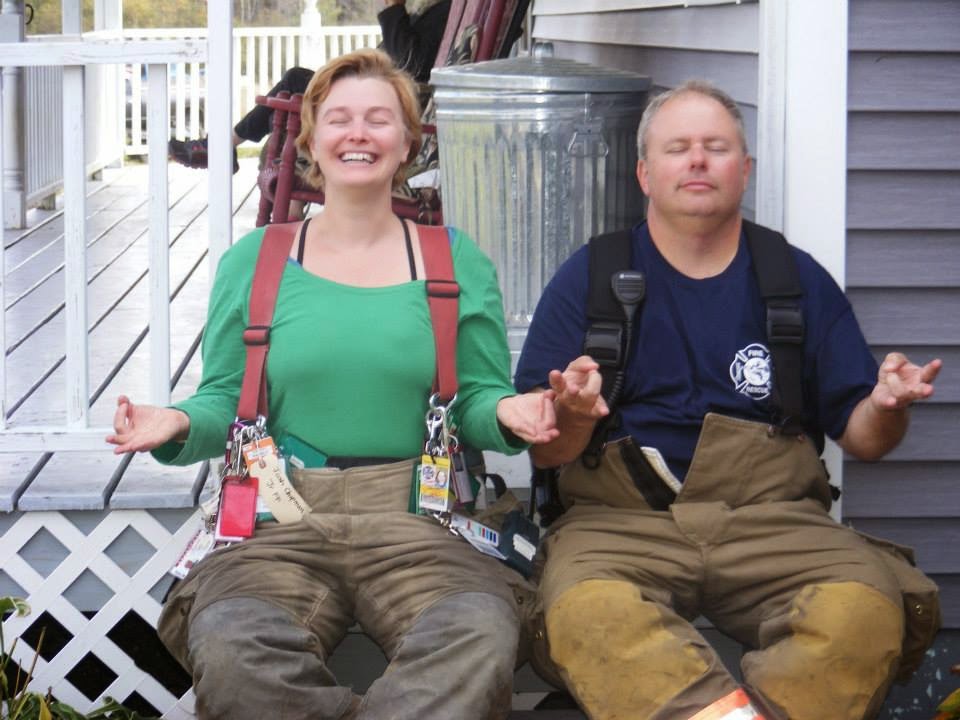
The notion that I could ever ascend to the ranks of interior firefighter seemed about as likely as my landing on Mars. For the first two years, I had to serve side-by-side with the woman responsible for my trauma. But I never quit. And then she left. And in the year that followed, I blossomed. Removed from the stress of that trauma trigger, I completed my EVOC training (which means I can drive fire trucks) and then I went on to tackle the vigorous, intense interior fire fighter training at the Hancock County Fire Academy. That training has beaten the crap out of me. And I still have three training weekends to go before I graduate from the Academy, but last night (almost three years to the day that I began this journey) my Chief told me that Marcus and I have now completed the minimum requirements for our department. 

No matter what happens from here on out, I am an interior certified fire fighter with the Orland Fire Department!! So put that in your pipe and smoke it! (But then dispose of your smoking materials safely.) 

I totally DID it!!! Namaste. (And thank you for believing in me.)


Photo courtesy of the Ellsworth American.

Labels: , , , , , , , , , ,

Tales from Rural Maine: Success

On May 22nd, 1994, my Smith College classmates and I stood in the hot sun in our black robes and we graduated. Then our lives diverged. We forged ahead. We gained, we lost, we suffered, we prevailed, we learned, we grew. We got older.
On May 22nd, 2016, (barring unforeseen disasters) I will complete my training as a (potentially) state-certified interior firefighter. Nothing in the whole wide world could have seemed more improbable to me on May 22nd, 1994. Nothing. I know for certain that the young "me" who stood in the sun that day twenty-two years ago, never, ever dreamed of moving back to her tiny home town in Maine and becoming a volunteer firefighter (or a yoga teacher, for that matter). If time travel were possible, I would put on my turnout gear, hop in my DeLorean and step out under the Emerson Arch in front of her just to see her face.
I have imagined doing this--traveling back to see her. And at first, I thought she (the young me) would *never* believe it. She would never in a million years be able to comprehend that she could or would ever do such a thing. I imagined that she would look at this 43-year-old fire fighting-yoga teaching me and just feel bewildered and frightened.
But then...I remembered. That girl? That young woman? As frightened and alone and overwhelmed as she was? As certain as she was that her path lay somewhere along the lines of motherhood and writing or something academic...despite all that, what I see in my mind's eye when I imagine traveling back in time to show her this fire-fighting-yoga-me...? I see her taking it in, processing it, and then...I see her smile! I see a look of shock and then a radiant smile that spreads across her face, dawning, as she realizes the awesomeness of the potential inside her. That girl I was, she didn't really know how big she was *inside*--and I love to imagine that if I could go back and show her, that she would *believe* it. And she would smile.
That girl--that young woman--I was, she is 43 years old now. And a PTSD sufferer. I have a genetic disorder that leaves me bruised, exhausted, and heavy. It makes my joints ache terribly. The doctors told me it was untreatable and incurable. And yet here I am. I'm teaching yoga. And I'm training to be a firefighter alongside young men who could bench press me if they wanted to. Half of them are young enough to be my children. And I go toe-to-toe. I hold my own. (I cry sometimes when I'm stuck in confined spaces, but I hold my own!)
(I think I may qualify for a spot on Marissa Walsh's next panel on "Not Quite What I Was Expecting.") smile emoticon
We're talking a lot--our alumnae community--these days about the definition of success. I think that mine comes down to this: Success is, more than anything, about creativity. If you have created solutions, opportunities, healing, growth, art, relationships, families, solitude, peace, progress, forgiveness, gratitude, laughter, or conversations--if you have *created* something, anything that matters to you (or to others), then I think you have succeeded. And you are succeeding if you are seeking and savoring joy. And perhaps, more than anything, you have succeeded if the "you" that is living now would make the "you" from May 22, 1994 smile as she realizes how very, very powerful, how very, very *big* you really and truly are.
Namaste, my fellow Smithies! (And remember to check your smoke detectors.) 


smile emoticon

Labels: , , , , , , , , , , , , ,

Fire Fighting Tales from Rural Maine: Never alone

Last night, my Hancock County Fire Academy classmates and I sat for the state written exam. If we pass it, we'll be half-way to our Fire Fighter I and II certifications. The second half is a skills test in June. (This does not affect our status as graduates of the Academy; we are all graduating, regardless of the results of the state exams.)
The test is hard. And long. 200 questions in three hours. It can cover anything from our 1100-page textbook, like for instance how much steel expands at certain temperatures or which NFPA standard covers fire fighter training regulations or what you would find in an MC-305 tanker truck or what you should do with the doors on a car while you are displacing the dashboard so you can free an entrapped passenger. (I didn't know the answers to any of those, by the way except that the standard covering training regulations is NFPA 1001. I'm sure that will be incredibly useful in my career as a firefighter :-)).
There were 19 of us sitting for the exam and as each one finished, he or she left the room. When the first people handed in their tests and left, I still wasn't even half-way through the first exam. By the end, there was just me and one other fire fighter slogging through the last part of our Fire Fighter II and watching the clock.
It was nearly 9pm when I finished. I'd had a long day and a long week and a long six months. And it was a little bit of a lonely feeling to know that I was going to walk out of that exam that we'd been working toward for six months, and there would be no one waiting for me, to say "How did it go!" or "We did it! Let's get a drink!"
I hung around in the exam room, darkening the circles in my bubble answer sheet for a while, so that my classmate wouldn't be all alone in there as he worked on finishing. But eventually, after going over and over all those bubbles, I started to get very anxious. Like I wanted to take the whole test out and start over, but there were only fifteen minutes left! So I decided to call it...and leave. My classmate and I gave each other a big smile and a thumbs up and I decided I'd go down to the fire bay and wait in the quiet darkness for him to finish, so at least he wouldn't be alone when he came out.
I walked down over the stairs and I had this little pang of sadness, to be second to last and all alone...and then, I caught a glimpse of my lead instructor standing between the trucks, in front of the open fire bay doors. Of course, he would still be there, I realized. He wouldn't leave us alone. But I wished that everyone else was there, too. So we could celebrate and share and mark the moment. But I also understood why people wouldn't want to hang around after they'd finished. Some of them had finished almost two hours before me.
When I rounded the corner, I saw that I was wrong to imagine I was alone. Almost every single member of my 19-person class was standing there, smiling, waiting for me and Jeff to finish our exams. My face lit up when I caught sight of them. I was not alone. I was never alone. I only imagined that I was. If there is one true thing that Fire Academy has taught us, it is this: we never do anything alone.


Labels: , , , , , , , , , , ,

Wednesday, June 10, 2015

Yoga Tales from Rural Maine: You've got to hug your farmer

Peter and I have a very small weekly food budget. It works out to be about $2.50 per person per meal for three meals a day, 7 days a week—and in weeks where there are very few yoga students, that budget drops even lower. There’s a direct connection between work and food for us, which is, by turns, equally stressful and beautiful. It grounds us, but it also often freaks me out. Finding creative, nutritious mostly vegan ways to feed us is a high-stakes adventure. Like everything in life, it’s a practice.
This spring/summer we have made the decision to dedicate 25% of our food money to fresh, local produce from our beloved local farmers. 20% of our weekly budget will go toward our CSA share in Lally Broch Farm, a compassionate and creative homestead doing really good work in the world. We had to pay in advance, which took some kerfoobling, but I made it happen because it matters; it matters in all sorts of ways. The other 5% will go to farm stand and farmers’ market purchases.
Yesterday, I got very panicky about my decision to write such a big check. What if the weather is poor and the farm’s crops fail? What if I’m too tired or too busy or too confused to find ways to prepare or store all of that beautiful perishable produce? In the past, my farm shares have often wound up being compost shares, because I had to compost so many things that wilted before I could figure out how to eat them. (What on earth does one do with celeriac? How much kale can one person really eat?)
But having taken a few years off from farm-sharing, I spent that time doing two vital things: healing my body and learning to cook. I’m still not 100% well, but I have enough energy and stamina to cook more often than not. And I’ve learned how to improvise with what I have in the kitchen. Armed with a salad spinner, a good knife, and my stick blender, I can make anything into a soup or a smoothie.
My hand shook as I took out my checkbook this morning to write my farm share check, but, like everything in life, eating well is a practice. Having faith in one’s ability to be healthy and strong and creative enough to cook is a practice. And if I know how to do anything, I know how to practice. This is what yoga teaches us. Don’t worry; just practice. So, I took a nice, deep breath. I let it out. I found my courage. And I wrote the check. Two and a half weeks of food money all at once, to one place. I made the commitment.
And I was rewarded by a visit from the kindest, most beautiful farmer you could ever imagine. She arrived as planned on my doorstep this morning, wearing striped tights (my favorite!) and beautiful jewelry she made herself out of eggshells (eggshells, I tell you!) and she handed me my pre-season delights: radishes, chives, fresh rosemary, thyme, & mint; beet greens and bok choy (I think); and a spring salad mix. All washed and neatly bagged and fairly broadcasting the loving energy with with they were planted and cultivated and cleaned and brought to me.
We stood there in the sunshine on this bright June day, both overjoyed. She thanked me for some kind things I had posted on Facebook, just when she needed them recently. Her eyes welled up with tears of happiness and gratitude. And when I opened my beautiful bag of greens and herbs, mine did, too. (She even threw in a welcome gift of lavender soap!)
I wanted to hug her, but I didn’t want to make her uncomfortable, so I said, “Are you a hugger?” And she embraced me in the warmest hug you could imagine and then she stepped back and smiled and said with jolly vibes and deep sincerity: “You’ve got to hug your farmer!”
Indeed, my friends, you really, really do.

My first pre-season delivery from Lally Broch Farm.

Labels: , , , , , , , , , , , , , , , ,

Saturday, May 02, 2015

Yoga Tales from Rural Maine: Be Yourself; Everyone else is already taken

Earlier this week, for the first time ever, I taught yoga classes in a mental hospital environment as part of a visionary experimental program to see if Yoga with Naomi will help the outpatient children at this hospital. It was also my first time teaching a very large group of children (12 kids in one class; 8 in another) across a wide age range (ages 5-12 in one class; ages 14-17 in the second). All of these students had different developmental and mental health challenges--and one student was in a wheelchair.
If you have ever worked with children--especially if you have worked with young kids who've been abused, neglected, traumatized, or maltreated; if you've ever worked with teenage girls who are suicidal, cutting, or otherwise fighting to hold it together (or, frankly, just teenage girls, in general); if you've ever had to corral a large group of kids of any age, regardless of their mental health status, then you quite rightly cringed, tensed up, or took a nice deep breath as you imagined what it would be like to be the grown-up in the room attempting to create an environment of calm and safe playfulness through yoga under these conditions.
Imagine how on earth you would learn everyone's names, deal with the fussing and fights and demands and moods and fidgeting and hyperactivity and trouble focusing and spats and stubbornness and fear and questions and all the other things that would likely happen in the room with 12 kids ages 5 to 12 (!)--plus all the stuff you couldn't anticipate--all while also trying to convey a message of kindness and calm and safety and self-empowerment through yoga.
I am trained as a children's yoga teacher using the ChildLight method, but other than that, I have no special training that equips me to work with this population. I literally had months to prepare my classes, which meant that I spent months fretting about how on earth this could work.
I kept thinking I wasn't qualified; how could I serve? I kept thinking I couldn't do it. It would be a disaster, a mess. It would harm the children instead of helping them. We'd go up in flames or down the drain--or both. It was completely overwhelming. I almost bailed on the whole project twice.
But one thing got me to this moment, and I share it with you now, because you know what? Teaching that day was *wonderful.* I'm telling you, it was WONDERFUL. It was a miracle. The classes went so well that instead of ending after half an hour, which we thought would be the maximum attention span for, say, a 5-year-old with ADHD, we were having such a good time, that I agreed to stay (unpaid) for an extra half hour. It was an investment in the future of the program, for me, and I was happy to stay. This happened in both classes! Even the surly teens in jeans wanted more yoga. And they wanted me to come back tomorrow! They won't actually see me for two weeks...but they loved class so much, they were eager for more.
I mean, really, is there a better day than the one where a teenage girl in a wheelchair tells you with a beaming smile that her back feels better? That she's happy? That she loves yoga?
That beauty may only have been topped by the miraculous awareness the youngest children had of what the right rules would be. When I told this group of 5 - 12 year olds that we had only two rules in yoga, "Kindness and Safety," and then I asked them what they thought that meant, they raised their little hands and--I swear to God!--said, "Listen" and "Observe personal boundaries." Oh, my darlings, YES! These are the rules. And I taught them that the very most important person to listen to is...themselves. Listen to your own body and your own feelings; take good care of yourself. Then, you listen to your teacher. They were SO good and SO smart and SO kind and SO intuitive and SO, just, delightful. Sure, some of it was bonkers, but that's okay. Everything was totally okay.
So, what was it that kept me in the game long enough to enjoy this very special day, this glorious feeling of happiness and victory? One thing: I was reminded by one teacher and one very good friend along the way of the most important thing of all... that I am me, Naomi, and that I am special, because there is only one of me in all of space and time, which, really, is what I am hoping to convey to these children, so it's a good thing that it finally sunk into my own noggin.
When we were in Costa Rica, my teacher reminded us of the truism, "Be yourself; everyone else is already taken." And on the one day when I was most freaked out about this upcoming series of classes and I was feeling totally unqualified and also utterly certain that I couldn't handle the hospital environment after having had a somewhat traumatic day of training there, my friend Whitney reminded me that I was specially chosen for this project, not because I hold a degree or special certification in this field; not because I have a long CV of work with this population of kids; I was chosen because I am me. I was chosen by the organizer of the program because of word-of-mouth about my classes, and because she came and practiced with me and then she knew with 100% confidence that I was the one, the one who should do it. (This, by the way, is also how I came to be working with cancer patients and survivors. Word-of-mouth brought someone to class who knew I would be right for the work. Not because of special training. Just because I am me.)
"Don't worry about the environment bringing you down," counseled Whitney on that dark day when I wanted to quit. "Trust with absolute certainty that your power of goodness and love is so great that you will bring the environment UP! These kids need you," she said.
And I believed her.
And so...on Sunday, the day before I was supposed to teach, after hours and hours of planning and preparing and trying to make up class plans that would be "perfect," I just decided: I can't be anyone else. They are already taken. I can only be Naomi. This can only be Yoga with Naomi. I can't use my intellect to "figure out" the best class plan. I can't rely on experience or expertise I do not possess. I can only teach intuitively and with tremendous love, joy, kindness, and patience. That's what I've got, that's why I was chosen, so that's what I'm doing. Come hell or high water, I'm just going in as Me. Naomi. The Yoga Teacher.
So, I did what I do with all my classes. I sketched out a plan. I set my intention. I packed a big bag of tricks. I said my prayers. And I showed up. I showed up and I shined. I loved. I taught. We laughed. We relaxed. We learned. We practiced kindness and safety.
And at the end of the day, almost every single person in the room felt happier and better in their bodies and a little more okay than they did when they walked or wheeled in. Whitney was right; of course she was.
I share this narrative partly because it just felt so darn *good* to teach those classes that day, and partly because I hope that if you, too, struggle sometimes to feel up-to-the-task or if you don't trust that you are special or worthwhile in the world; or if you're trying to be someone other than yourself, that this will be your reminder to honor your own inherent goodness, to honor your gifts and talents rather than focusing on how you think you "should" be.
I thank Whitney and my teacher Jillian Pransky for reminding me of this wisdom.
I'm actually really proud of the courage it took for my heart to understand that she is much greater than she thinks she is, despite all the evidence I presented to myself to the contrary. Today, my Heart and my Self trusted that I am special, and I only needed be Myself to get the job done (and done with beauty)...which is lucky...seeing as how everyone else is already taken.smile emoticon


I told this story in some of my classes this week, to share the message and to encourage us all to practice being ourselves without apology or doubt. Our mantra was, "I am" or "I am enough."

Labels: , , , , ,

Tales from Rural Maine: Beasts

The other day, a flatbed tow truck drove past my house towing a school bus. It was like King Kong carrying an unconscious Godzilla out of the city.

Labels: , , , , ,

Wednesday, April 22, 2015

Tales from Rural Maine: Understanding time

When my nephew was very little, he seemed to have an unreasonable level of frustration when he was told to wait for a very short time. He wasn't a naturally impatient person, but for some reason being told to wait "a minute" left him feeling hopeless, as though you had said an hour instead of a minute.
My a-ha moment came when I realized that for Bailey, "a minute" didn't mean sixty seconds. It literally meant, "some-long-interminable-indeterminate-amount-of-time-that-generally-means-a-grown-up-isn't-willing-to-say-no-but-also-isn't-willing-to-do-what-was-asked-of-them-right-now."
We were all saying, "In a minute, Bai!" when he asked to play or get help or get attention or have a treat or any and all of the other things kids are needing when they're three. He hadn't yet learned about measuring time on clocks; his understanding of words and of time came from his experience. "A minute" could be counted on to be a frustratingly long amount of time.
As I stood on Tuesday night in the kitchen staring at the heap of dirty dishes that Pete said on Monday morning that he'd wash "later," it occurred to me that what he meant was...he'd do them "in a minute."

Labels: , , , , , , , , , ,

Thursday, April 09, 2015

Yoga Tales from Rural Maine: Holding up the sun

Last night, I showed Peter a picture of me and my friends spelling L-O-V-E with our bodies on the beach at sunset in Costa Rica. I had shared it on Facebook, but he doesn't social media much, so he hadn't seen it. 


He appreciated it. And then he said, "You know, I really love that one of the girl holding up the sun at the beach." 


(This photo is my profile picture.) I looked at him, realized he wasn't kidding, laughed and said, "Honey? That girl is me."

Labels: , , , , , , ,

Monday, April 07, 2014

Yoga Tales from Rural Maine: Bridge the gap

Yesterday, I faced two big fears: bridges and running. This was a big deal on both fronts. There is one bridge, in particular, that scares the bejeezus out of me; the Penobscot Narrows Bridge, which spans the Penobscot River between Prospect and Verona Island in the bay of my home town. I don’t even like to drive across this bridge. I avoid it like…well, like a bridge. I refer to it as “The Bridge of Death,” and not because so many people have jumped off it. It—and its predecessor, the Waldo-Hancock Bridge—have always filled me with a deep sense of deadly, deadly foreboding. I would no sooner walk (or run) across that bridge than I would volunteer to be buried alive.

Image courtesy of Bangor Daily News


And the running…why fear running? Especially someone like me, who was a multi-season All-State athlete, who loves to train, to compete, to run and to play—why fear a run? There are two reasons. The first is a fear based on past injuries. It’s a sort of nameless, generalized fear. I’m not sure I specifically fear another injury, or fear that I’ll aggravate an old one; although maybe that’s it. It’s hard to say, exactly, but the thought of road races—something I used to enjoy—triggers a feeling of panic and dread. My psyche does not want to experience the things I’ve gone through, with injuries, again.

I have injured my right knee severely, twice. The first time in 1999 while training for the San Francisco marathon. I tore something in the tenth mile of a twelve-mile training run just two weeks before the race. I finished all twelve miles of the run, limping through the last two, and I wound up having surgery instead of running the marathon. The rehab was long and painful and I never fully recovered the strength or muscle-mass in that leg.

The second injury, to the same knee, was even more severe. In 2007, I was in the best shape I’d been in since the marathon training injury in 1999, and then one horrible afternoon in June, I slipped on wet paint during a backyard volleyball game—the last point of the day!—and severed my ACL. In one horrible twist, that ligament was ripped fully off my femur, and I hit the ground with so much impact, I bruised the bone.

For eight months I was in terrible pain, and all alone in that pain. No comfort, no assistance, no support. The first few weeks were a struggle to survive, as I couldn’t drive, my knee was swollen like a grapefruit, I was in terrible pain, and there was no one to help me do simple things, like get food or do dishes or get the laundry up and down two flights of stairs. I remember asking an old friend if she could spare half an hour to help me one day and she said, “No.” She had to study for her bar exam. Everyone I asked was usually too busy and I sank into a deep and desperate despair and gave up asking. While I know that things are different now—I have Peter, friends and family, who would help me--the experience of being utterly destitute, living in a constant level 8-to-9 pain, and being so very hungry, are scars on my psyche that may never heal. To run a race, I have to face all of that deeply ingrained life-threatening terror.

I didn’t have reconstructive surgery after the ACL tear because I have a non-ACL-dependent knee, it turns out. The orthopedic surgeon said my right knee was as stable as it could be, under the circumstances, and surgery would not improve it. I did a lot of painful, grueling rehab, but since that day almost seven years ago, when my ACL snapped, I have been afraid to run or play any sports. I lost a huge part of myself that year.

I have always been a person who enjoyed sports and running very much. Tennis? Volleyball? Football? Count me in! I am an athlete. In the same way I am a woman, a Smithie, an American—“athlete” is inextricable from who I am. I’ve never been the greatest at endurance, but when I injured my knee the first time, I was doing well; a six-mile run was an easy day. I was never the fastest distance runner; a ten-minute-mile training pace for anything over 5K was about the best I could do. But I loved it.

All through my twenties, I was still playing in recreational volleyball, basketball and elite soccer leagues in Northampton or San Francisco. But since 2007, I have felt afraid. My knee often hurts and feels unstable. It makes bad noises and it just doesn’t feel safe to do anything with quick stops, starts, or pivots—or anything that requires pounding the pavement.

And, worse than that, there is a second aspect to my fear of running. This fear is dark, specific, and rational. Ever since 2007, I have been unable to recover from exertion.

You may think that’s an overstatement; or perhaps it’s a statement that just confuses you. How can a person not recover from exertion? If you think either of these things, it’s because your body does it for you without you having to think about it. My body no longer does.

I injured my knee in June of 2007. That same month my truck (to which I had a deep emotional attachment) died, my beloved cat Calvin died at the age of 12, and I turned 35. I was suffering terrible physical and emotional pain, and was completely alone, as well as financially strapped. I worked very hard to keep myself alive, to heal, but I wasn’t doing well. In August, I saw a psychiatrist about my depression and he put me on a very small dose of Prozac. Over the next three weeks, I gained 30 pounds without changing diet or exercise. The depression did not lift, but I gained 16 inches on my waist and three cup sizes in my bra. And I became unable to recover from exertion.

I went back to the psychiatrist who took me off the Prozac, but none of my symptoms improved. I have spent the last seven years seeing doctor after doctor, specialist after specialist looking for answers. Most of them told me to exercise more and eat less. When I told them I was already on a low-calorie diet and that I couldn’t exercise because it made me sick, they didn’t believe me.

“You are constitutionally flawed,” said the prestigious endocrinologist I’d waited months to see. “There is nothing western medicine can do for you.” He didn’t do a single blood test. No lab work. Just looked at me, listened to my heart and my lungs, asked me about my medical history (starting from the day I was born) and then rendered his verdict.

I once told a friend that I was frustrated because exercising made me sick. “It’s like I’m allergic to exercise,” I confided to her.

She laughed. “I know, right? Nobody likes exercise.”

“No,” I said. “My body actually does get sick. It’s like I have the flu.”

She winked. “Exercise makes me sick, too.” No one seemed to understand.

I got a similar reaction from almost all of the doctors and nurses I saw. I couldn’t make them understand.

“Listen,” I would say. “If I go run—at this point, if I even go for a gentle 20-minute walk—I can do it. I can rally and find the energy and I can do that. Sometimes I can even do it for two or three days in a row. But then, I will get flu-like symptoms that are unbearable. I will have body aches, headaches, runny nose, sore throat, sneezing, coughing, and the most incredible weakness and fatigue you can imagine. I can barely move.”

I told this, over and over, to doctors and nurses and nearly every one of them told me to exercise more and eat less, or that I was just getting older. Some of them put me on birth control pills, which only made me sicker.

By 2009, I was so sick that during the end of my monthly cycle each month, I was too weak to walk or stand. I relied on a wheelchair if I had to do anything more than just a few minutes of walking. I was miserable, weak, clinically obese (having not yet been able to lose those 30 pounds), and every single time I tried to return to my loves—hiking, walking, running, biking, working out—my body would collapse. If I hiked for an hour one day, I would feel like I had the flu for the next three weeks. One hour of hiking would cost me three weeks of my life. It was a high price to pay. For those three weeks, I would barely be able to cope with daily tasks; eating, sleeping, brushing teeth were almost all I could manage.

So when I decided to run across that bridge yesterday, as part of the Bridge the Gap race, I was not only facing my fear of that (terrible) bridge and the nearly uncontrollable urge I have to fling myself off it every time I’m on it (not from suicidality, just because that’s what happens to me with heights), I was also facing my fear of losing the next three weeks of my life. I was facing my fear of collapse and embarrassment. I was facing my fear that I am old, constitutionally flawed, and will never be able to run again.


I set the goal to run that race—just the Fun Run, the first mile across the bridge, not the 5K or the 10-mile—the year before. I began training in October, running diligently every single day on my elliptical machine. I started gently, very gently, running five minutes each day, slow and easy. And I was overjoyed that I was okay! No flu! No symptoms. I could do five minutes a day—about 6/10 of a mile—and be fine. I was overjoyed.

This small bit of daily running was possible because in 2013, I finally found a nurse practitioner who believed me. She not only believed me, she immediately recognized my symptoms and knew what to do. While it has been expensive and hard work, and while I still have a long way to go, for me, in this particular body, at this time in my life, the ability to run five gentle minutes a day, every day--it was like summiting Everest. I loved it. I gave exuberant reports to my nurse practitioner and to Peter. It was exciting.

In November, I moved up to six minutes a day—7/10 of a mile. In December, seven minutes a day, 8/10 of a mile. January, eight minutes a day, 9/10 of a mile. I was doing great, and I was on target to be able to run the mile-long race over the bridge in April. This was happening!

One of the things I have done with my improved health and wellness is to join a volunteer fire department. It is remarkable that since 2011, I have gone from wheel-chair-dependent to yoga teacher and firefighter—and I had set my sights on being a runner again, an athlete who could do things.


Every now and then, I would look at my situation and feel embarrassed and demoralized. Who has to train with this much devotion and dedication to run one mile? But the key to my recovery has been, in part, a compassionate approach to understanding the biomechanics of my system. An essential part of my healing has to be compassion; anything else only stresses my system and actually makes the problem worse. Being ashamed of my size, my limitations—this only increases my size and my limitations. Shame does not serve me.

What I understand now, thanks to the insights of my wise young nurse practitioner and the very helpful book Are You Tired and Wired? (Marcelle Pick), is that I am not “constitutionally flawed.” My body had a very natural, very understandable, very treatable reaction to prolonged, unremitting stress. I have endured so much stress and trauma in my life, right from the very beginning, that by 2007, I was poised for collapse. It’s really a miracle that I made it that far. With all of the intense physical and emotional stressors that exploded that summer, and the addition of the Prozac, my system “flatlined,” as Pick would say. I demonstrated all of the classic symptoms.

In August of 2013, I took a diagnostic quiz (Are You Tired and Wired? pp 57-58). A score of 26 or more would have indicated that I was suffering from severe adrenal dysfunction. My score was 83. Why had no other doctors put this together before?

I decided I couldn’t think about that question.

“Aren’t you angry?” my sister-in-law asked one day, as I shared with her what I’d learned and how much it was helping me. And I realized, I wasn’t. I was too grateful for what was happening now to think about all the ways in which those other practitioners failed—and even harmed—me.

This run across the bridge was going to mean something big. It was going to mean that I could be well. It was going to mean that if I am slow and steady and faithful, I will, perhaps, one day be a person who can go jogging, bike-riding, hiking again. It represented my commitment to rise up out of helplessness, fatigue, and despair, and cross that bridge to wellness.

My future felt bright and I felt elated each month when I added another minute to my daily run and remained without side effects. But then, on January 6th, I had an accident during firefighter training. I suffered a concussion and a severe neck sprain with repercussions for not only my cervical spine, but my thoracic spine and shoulders. The blow was so hard and at such an angle that the damage was extensive.

The next three months were a nightmare of pain, sadness, brain fog, and isolation. There were many aspects of the injury and the worker’s comp bureaucracy attached to it, which were unbearable. Not only did I no longer have access to firefighting, I also did not have access to yoga, to my students. I couldn’t teach or practice. And I couldn’t do my daily run.

The Bridge the Gap race I had set my sights on was going to come, and it looked like I was not going to be able to do it. And yet…a few weeks prior to the race, I was finally cleared by my doctor to return to full-duty with the fire department on a trial basis. My physical therapist encouraged me to resume normal activity and see how it felt. I was afraid to climb back onto my elliptical machine. Afraid to face the inevitable losses; afraid to experience how winded, and weak and tired I’d be; afraid of the potential return of the flu-like side affects; I was afraid to begin losing days again.


During the worst days of my injury, in January, my concussion combined with my migraine disorder, made it impossible for me to think. Literally, if I formed thoughts or if I used my eyes to watch TV or read or even look out the window, it would trigger cascading migraines, blinding, searing, indescribable migraines. The only thing I could do was to lie in restorative yoga postures, close my eyes, and listen. Listening would keep my mind from forming thoughts. Music made me too emotional, so I listened to stories. Story after story after story. Whatever I could get my hands on. I even listened to James Earl Jones read the bible. (There sure is a lot of “begetting” in that book.)

My brain injury, combined with the loss of income, the loss of almost everything I held dear, the heartless and crazy-making bureaucracy of worker’s compensation, and the pain--good God, the pain…it was too much. I was struggling, all day, every day. And then one day, I had a thought. It was like a key clicking into a lock. “Kill myself.” I felt a wave of relief. The world felt so simple, so clear. I can’t accurately describe the rightness of this thought. Nothing in my whole life had ever felt so purely correct, so absolutely, perfectly right as that thought. If we had had a handgun in the house, I’m certain I would no longer be here. For some reason, it had to be a gun, in this thought. It was so simple, like opening a door if you wanted to go outside. Why wouldn’t you?

Because my gun is a .22 rifle, it wouldn’t do the job. My mind then went to the bridge, as a second thought. Without a brain injury, and without the exacerbating forces of the nightmarish experience of trying to work through a worker’s comp claim—a process my occupational medicine doctor describes as “uniquely adversarial,” and which, according to him, drives everyone (100% of his patients who have to deal with it for more than three weeks) into a deep, unrelenting depression, so much so that he asks everyone to take a sanity questionnaire when they visit and he keeps referral cards for suicide hotlines in his office—without those things, I would not have had that thought. I’m certain of it. It wasn’t like me.

I know for certain that were I to have had a suicidal thought, without the influence of the brain injury or the inhumanity of the worker’s comp maze, I would have thought of gas or pills or something really gentle. I am not a girl who would shoot anyone—or anything—especially myself; and I am not a girl who would willingly step foot on a bridge if there were any other alternative. The fact that guns and bridges felt right to me shows, even more than the suicidality, that something in my brain was absolutely not functioning normally. Without a properly functioning brain, we are at the mercy of thoughts we have no way to control.

So it was the lack of a pistol in my home, more than anything else, that saved me from dying that day; and it was my experience as a first-responder, looking for the body of a man who had jumped from that bridge, that kept me from jumping that day myself. My misfiring brain was, thank goodness, able to at least put these thoughts together. First, that my gun couldn’t get the job done, so don’t try; and second, I could remember the experience of being out on the water looking for a body; I knew what that was like, and because of that and only that—the thought that I couldn’t possibly ask Bobby or Julia or John or Casey or Dave to go out into the bay to recover my body—I lived. My malfunctioning brain was able to find those two logical thoughts within its buggy programming, and it saved me: “The gun won’t work" and, "You can’t hurt your first-responders; you love them.”


Once I’d made it past that thought, which took about 18 hours, it was like putting on a new skin. I shed my injured, crazy skin, the one that had been created on the day my skull rammed into that fire truck, and I stepped forward, lighter, more peaceful, and aware that I needed to meditate—and pray—if I were going to hold myself together. I would stop fighting for anything from worker's comp. I would pay my own way. None of this was worth dying for. It became a life-and-death battle and I wanted to make certain that my brain knew to choose "life."

Eventually, I developed a new daily practice, of meditation, mantra, and prayer, and I have done this without fail. In the same way that I ran every day before I was injured, I have come to my meditation, mantra and prayer each day with devotion.

And it was this—more than anything—that got me to the bridge yesterday. I was afraid to face the place where my friend’s sister had jumped, just a few days after I decided not to; I was afraid to face the place where I almost jumped. I was afraid of hurting my knee. I was very afraid of collapsing half-way across and suffering the humiliation of publicly demonstrating that I could not run a mile. And I was afraid of losing weeks of my life to the recovery process, even if I did make it across.

But here’s something else I’ve learned from yoga and volunteering as a firefighter: I can do it. It doesn't matter what it is; if I decide to do it, I can do it. I can do 108 Sun Salutations, if I set my mind to it. I can stand on my feet for hours at a training or a fire scene, knowing it will take days or weeks to recover, that my knee will swell and my body will ache, and I can do it. I can even smile while I’m doing it. And I can go out, in the cold and the rain in a tiny little boat and look for a body under the bridge, even though every single one of those things terrifies me. I know this about myself. I know it so deeply that even when I was lost in the confusion of a battered brain, I accessed that knowledge.


When I meditate, I meet myself in the place inside myself where I know I’m okay. I know how to get to that place because I have worn a steady path to it, day by day by day. I know how to be confident in my ability to get things done, difficult things, and I know how to breathe. Thanks to my meditation and yoga practice, when I decided to run yesterday, all the buzzing fear stayed out around the edges, and the only thing that existed was the here and the now, this breath, this footstep, this moment, this me.

And that’s how I ran the race, the same way I meditate. Inhale, count to four, exhale, count to four. I just did that, over and over and over. I kept my eyes straight ahead, I put one foot in front of the other--and I let myself be loved. My friends, my students, had come to be with me in this. They ran with me, on either side and behind, and one was waiting at the finish line. And so, I was transported, across the Bridge of Death, one footstep, one breath, (one silently uttered curse), at a time, until I was on the other side.

I often tell my students, we can get through anything—get over or under or beyond anything—if we do it one breath at a time. We can bridge any gap this way, if we are kind to ourselves, if we are devoted, and if we have the courage to try.

Post Script: I was among the last to cross the bridge yesterday, having been outrun by at least a dozen small children, but it didn’t matter at all that I was nearly last. I have never been the sort of athlete who needs to win. I love winning, don’t get me wrong, but what I love most of all, is excellence; I love doing my best, and that is what I did yesterday. My best is measured only against myself.

It was important to me to prove to myself that I had the heart to do this without stopping. No matter how much my body screamed in protest, I wanted my willpower to keep me going. And it did. My body was not in good enough shape for that run, but I made it do it anyway, and for an athlete, that is a victory.

For a person recovering from severe adrenal fatigue, unfortunately, it is not a victory; it’s a setback. Within ten minutes of finishing the race, my body’s immune response was bull-blown. My nose was running like someone had turned on the tap. I was sneezing incessantly. I drove myself home, drank water, took homeopathic remedies. My eyes and throat itched, my sinuses tingled non-stop, as though I’d just sniffed pepper. I had lots of energy and enthusiasm for about an hour, but then the collapse took hold. By the time Peter came home from work three hours later, I was in bed, too weak to move. Face raw, already, from hundreds of nose-blows. My head was stuffy, my chest was burning, my voice was nasal and scratchy, and I was so weak I could barely lift my head.

I had taken a Claritin the night before. I took two Benadryl when the allergy-like symptoms began to peak. It didn't really help. Peter fed me. And I kept drinking water and taking homeopathics. I was glad I had triumphed over the bridge, but so incredibly sad that my body was collapsing. I lost all of Sunday. I took more Benadryl at bedtime, along with a Flexoril, and I turned off my emergency dispatch pager. I would be no good to anyone at a scene, and I needed my rest.

I woke up this morning and my eyes were almost swollen shut. They were not infected, just reacting as if they had encountered an allergen. They remained dry, itchy and slightly swollen most of the day. My throat hurts. My nose runs. I’m tired and sneezy and my lungs burn. I am weak. Too weak, I think, to go to my firefighter training tonight, and this makes me incredibly sad. I want to put on my turnout gear and learn about fire extinguishers. But...I can't. It is the sadness I feel, even more than the physical symptoms, that makes the experience of being in this body hard. Whenever I do one thing—like run a race—and then I have to pay a heavy price, like losing every other activity for days, I feel the loss keenly. It is one of the things I was afraid of when I thought of running across that bridge. And...it happened.

It was neither kind nor gentle of me to run that race when I knew my body couldn’t take it. I was sad and humiliated as my friends rejoiced on Facebook about our run, and asked if I wanted to run a 5K next month. They, of course, have no idea what that race cost me, and how ill-equipped I am to run a 5K right now--or how badly I want to be able to. Feeling ashamed about this is counterproductive; and yet, I do. There is a level of self-acceptance that I have still not reached. I still see myself as able-bodied and athletic, and every single time I realize I am not, I grieve all over again.

My work today—and every day, even after I am finally well—is to practice self-acceptance. To practice lovingkindness, to my Self. To allow myself that grief, for what is lost when I feel it, but also to connect with the joy of what is. To let that grief be water under the bridge, and to be with the joy of acknowledging that I was brave, I was well-supported by loving friends, and ultimately, the joy of being able to run across that frigging bridge—because I did make it! I did run that mile without stopping. I could not have done that at any other point in the last seven years. Flawed as it still is, this is progress.

My “Bridge the Gap” race my have been slow, and it may have been a little too much for my physical body right now, but the fact that I did it proves that this combination of yoga, meditation, prayer, the care of a good nurse practitioner, and volunteering as a firefighter have given me the tools I need to bridge the gap between illness and wellness. It also proves I have a long way to go. I intend to get there, one little breath, one giant bridge, at a time.

Labels: , , , , , , , , , , , , , , ,