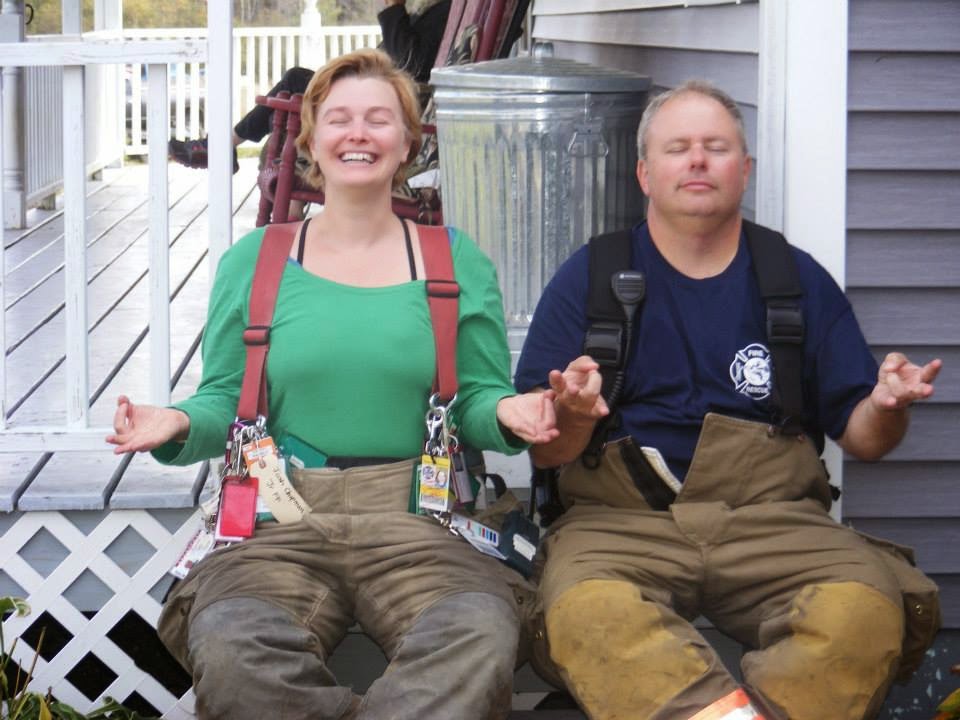
Wednesday, April 22, 2015

Tales from Rural Maine: Understanding time

When my nephew was very little, he seemed to have an unreasonable level of frustration when he was told to wait for a very short time. He wasn't a naturally impatient person, but for some reason being told to wait "a minute" left him feeling hopeless, as though you had said an hour instead of a minute.
My a-ha moment came when I realized that for Bailey, "a minute" didn't mean sixty seconds. It literally meant, "some-long-interminable-indeterminate-amount-of-time-that-generally-means-a-grown-up-isn't-willing-to-say-no-but-also-isn't-willing-to-do-what-was-asked-of-them-right-now."
We were all saying, "In a minute, Bai!" when he asked to play or get help or get attention or have a treat or any and all of the other things kids are needing when they're three. He hadn't yet learned about measuring time on clocks; his understanding of words and of time came from his experience. "A minute" could be counted on to be a frustratingly long amount of time.
As I stood on Tuesday night in the kitchen staring at the heap of dirty dishes that Pete said on Monday morning that he'd wash "later," it occurred to me that what he meant was...he'd do them "in a minute."

Labels: , , , , , , , , , ,

Thursday, April 09, 2015

Yoga Tales from Rural Maine: Holding up the sun

Last night, I showed Peter a picture of me and my friends spelling L-O-V-E with our bodies on the beach at sunset in Costa Rica. I had shared it on Facebook, but he doesn't social media much, so he hadn't seen it. 


He appreciated it. And then he said, "You know, I really love that one of the girl holding up the sun at the beach." 


(This photo is my profile picture.) I looked at him, realized he wasn't kidding, laughed and said, "Honey? That girl is me."

Labels: , , , , , , ,

Wednesday, August 27, 2014

Tales from Rural Maine: The way life should be…

I was delayed getting to my uncle Ricky's memorial gathering on Sunday. First, because I was so incredibly sad, I couldn't put my clothes on. Second, because a goat climbed into my car. And third, because on my way there, I came upon an accident involving my other uncle—Ricky’s younger brother--who was trying to find the memorial in his rental car and got sideswiped by a speeding SUV (with out-of-state plates, I might add).
The goat in question is named Dixie and she belongs to Dave and Angel, fellow members of the Orland Fire Department. Pete and I swung by their place on our way to the memorial to drop off Pete’s Jeep at Dave’s garage, and as soon as I pulled up, Dixie made a bee-line for me.
I’ve only met Dixie once before and usually she lives with the other pet goats in a backyard pen equipped with lots of things to climb on. I suspected she wasn’t meant to be free ranging since the other goats were in the pen and Dave and Angel seemed not to be home. Two little girls were playing in the yard, though, and they said it was okay for Dixie to be out, so I took their word for it. I gave Dixie some pets and scratches, and then headed back to the car with Pete. Dixie followed.
She was utterly and sweetly fixated on coming with me. I would lure her away from the car and then dash back and she would gallop on her little hooves to catch up with me. The girls tried calling her to them, but she could not be dissuaded from this notion that she and I should be together.
Pete opened the passenger-side door to get in, but Dixie climbed in ahead of him. She is a small, brown goat, and she wanted to come with me. To be honest, I sort of wanted her to come with me, too. There was something so endearing and healing about her warm interest in my being. The week had been so hard. Some of my relatives are tough to be around. I listened to and experienced way too much judgment and criticism for my own comfort. It left me feeling ragged and alone. But in Dixie’s unabashed desire to be with me, I felt fully appreciated. This guileless little being, her affection, her warm and willing eyes, they soothed the hot sense of disapproval I had felt radiating at me all through the week.

Dave, our 1st Lieutenant, and sweet Dixie

I’m not sure how discerning Dixie is. It may be that every human who enters that yard has to remove a friendly goat from their passenger seat, but for me, in that moment, it helped me to feel more like me. For the first time that day, I laughed. I giggled. I talked to Dixie. I loved her. And with that love, with that laughter, I began to feel a bit more like myself, a bit less traumatized, a bit less lost and alone in a wilderness of thorns. It was like I had wandered off the internal path I follow, the quiet and lovely path that keeps me grounded, happy, and whole, and Dixie turned up to show me the way back. Eventually, we were able to separate ourselves and I left Dixie in the care of the neighbor children, and drove off, a bit late, for the memorial gathering.
The memorial gathering was a casual affair. A time for friends and family simply to gather. No speeches or eulogies, just food and drink and a couple of hundred people who knew my uncle, gathering in the sanctuary-like yard of some dear friends who live on Cedar Swamp in East Orland. Don’t let the word “swamp” fool you. It’s truly beautiful there, back in the woods. It’s all trees and birds and flowers; deer and happy chickens and raised beds full of green and growing things. There is a constant and gentle trickling of water from the artesian well, and a sequestered sort of openness that allows one to feel both safely ensconced and utterly free all at the same time.
After leaving Dixie, Peter and I drove directly toward the memorial. But just before the last turn, we came upon an accident. We were in Orland, so of course I stopped to offer assistance. There were no emergency vehicles on site, just a large group of dazed and miserable looking people—about half of whom I was related to--and two SUVs looking worse-for-wear on the side of the road. I soon discovered that one of the smashed vehicles had been driven by Uncle David and that several of my younger cousins and my 11-year-old niece were passengers. The girls were very shaken up and had already been picked up and driven back to the memorial by other family members, as everyone else involved waited for help. Thankfully, no one was seriously injured; but both cars were now undrivable, and my uncle, my cousin, and my aunt’s husband were in limbo, standing in the heat next to a smashed up rental car, looking for all the world exactly like what they were—tired, sad, shocked, stranded travelers.
Orland was never dispatched to the scene—I’m not sure why--but nevertheless, in this moment of crisis, two of my firefighters materialized anyway and gave assistance with grace, calm, and the deep and generous kindness I truly love them for.
First-on-scene was Dustin Bowden, a young man who lives nearby and heard about the accident from his grandmother. This is how we roll in rural Maine. Your grandmother drives past an accident and gives you a call and you are a volunteer firefighter, so you go out looking for it. Dustin and I secured the scene, called for an ambulance, and made sure the sheriff was notified.
Soon, our second captain, Casey Soper arrived. I was so happy to see him. He’s tall and deeply tan from long days of lobster fishing, and he scooped me into a bear hug. Serving with Casey is like having a big—very big—younger brother who knows when to crack a joke, when to play wrestle, and when to take command of a scene. The second time I met him, we were in a fire truck—he was driving—and he told me he would trust me with his life, and that there are not a lot of people he feels that way about. I have endeavored ever since to be worthy of this trust.
Between the three of us, we were able to expedite the tow truck for both cars and get my family on their way with a blessed efficiency. Just to provide some perspective: The last time we (the OFD) were at an accident scene with an out-of-state driver in a rental car with no AAA (just like my Uncle David), it took four hours to clear the scene and the chief wound up driving the family to Trenton to get another car. But this time, using my AAA card and Casey's inside knowledge (one of his many talents is tow-truck driving), we were able get this wrecker call taken care of in a fraction of the time it would have taken, had Casey and I not been there. I was overjoyed at our useful and helpful connections to one another, and within our community, and that whatever fortuitous forces were at play that day had brought the exact right people to that scene to be of service to my family.
I emerged from the incident grateful, as ever, for the members of the OFD, for my friends and family here in this small town, and for the very quick response and congenial nature of the deputy sheriff on scene.
Even though I was an hour and a half late to the memorial, and a lot of people had left by the time I got there, the silver lining in that particular terrible cloud is that--as it turns out--the perfect combination of things to draw me out of weak-kneed, weepy inconsolability is a very friendly goat, followed by first-response. The accident—particularly since it involved my family—meant that I switched from upset-and-grieving into calm-competent-firefighter. Nothing in the world existed in those moments except the roadside problem at hand and the tools I had at my disposal to fix it. When everything depends on my presence of mind, nothing is present in my mind except my compassion, my instincts, and my training.
When people say, “Maine, the way life should be,” I don’t think about mountains or rocky coasts or lobster that is cheaper by the pound than hot dogs, I think about Dustin Bowden, jumping in his car to come and help because his grandmother saw an accident near the blueberry factory; I think about Casey showing up and giving me a hug after a long, hard day of working on a lobster boat and taking out his battered phone and saying, “Yes,” when I asked if he could help me get a AAA tow truck there quickly; I think about the scraggly wrecker drivers who didn’t know me, but when I climbed up to the cab and explained I was a friend of Dave’s—and Dixie’s—they smiled (they know them both well) and said yes, they’d tow my uncle’s vehicle first, so that he could get to the memorial; I think about those hundreds of people who came to East Orland to say goodbye to my uncle, people who had known him when they were children, having adventures with the Gangs of Bucksport; I think about how those were the days; and I think about the heavy, black pager I wear on my hip at all times, even when dressed for a funeral, and the kindness and competency it always summons when people need it most.
Once the drivers and passengers had all refused medical transport; once the sheriff had released the scene; once my uncle David’s rented Expedition was on the way to Dave’s, I thanked Dustin and Casey, and I climbed back into my little Ford Focus, stuffed with yoga supplies, and firefighting gear, and two bouquets of flowers from my garden for the memorial.
"There's no crying in first response," I joked to Peter, once we were both safely back in the car.
"This car smells like goat," he said.
And we were on our way. 


Me and Dustin taking a break at a long, sweltering structure fire in Surry.


Labels: , , , , , , , , , , ,

Monday, April 07, 2014

Yoga Tales from Rural Maine: Bridge the gap

Yesterday, I faced two big fears: bridges and running. This was a big deal on both fronts. There is one bridge, in particular, that scares the bejeezus out of me; the Penobscot Narrows Bridge, which spans the Penobscot River between Prospect and Verona Island in the bay of my home town. I don’t even like to drive across this bridge. I avoid it like…well, like a bridge. I refer to it as “The Bridge of Death,” and not because so many people have jumped off it. It—and its predecessor, the Waldo-Hancock Bridge—have always filled me with a deep sense of deadly, deadly foreboding. I would no sooner walk (or run) across that bridge than I would volunteer to be buried alive.

Image courtesy of Bangor Daily News


And the running…why fear running? Especially someone like me, who was a multi-season All-State athlete, who loves to train, to compete, to run and to play—why fear a run? There are two reasons. The first is a fear based on past injuries. It’s a sort of nameless, generalized fear. I’m not sure I specifically fear another injury, or fear that I’ll aggravate an old one; although maybe that’s it. It’s hard to say, exactly, but the thought of road races—something I used to enjoy—triggers a feeling of panic and dread. My psyche does not want to experience the things I’ve gone through, with injuries, again.

I have injured my right knee severely, twice. The first time in 1999 while training for the San Francisco marathon. I tore something in the tenth mile of a twelve-mile training run just two weeks before the race. I finished all twelve miles of the run, limping through the last two, and I wound up having surgery instead of running the marathon. The rehab was long and painful and I never fully recovered the strength or muscle-mass in that leg.

The second injury, to the same knee, was even more severe. In 2007, I was in the best shape I’d been in since the marathon training injury in 1999, and then one horrible afternoon in June, I slipped on wet paint during a backyard volleyball game—the last point of the day!—and severed my ACL. In one horrible twist, that ligament was ripped fully off my femur, and I hit the ground with so much impact, I bruised the bone.

For eight months I was in terrible pain, and all alone in that pain. No comfort, no assistance, no support. The first few weeks were a struggle to survive, as I couldn’t drive, my knee was swollen like a grapefruit, I was in terrible pain, and there was no one to help me do simple things, like get food or do dishes or get the laundry up and down two flights of stairs. I remember asking an old friend if she could spare half an hour to help me one day and she said, “No.” She had to study for her bar exam. Everyone I asked was usually too busy and I sank into a deep and desperate despair and gave up asking. While I know that things are different now—I have Peter, friends and family, who would help me--the experience of being utterly destitute, living in a constant level 8-to-9 pain, and being so very hungry, are scars on my psyche that may never heal. To run a race, I have to face all of that deeply ingrained life-threatening terror.

I didn’t have reconstructive surgery after the ACL tear because I have a non-ACL-dependent knee, it turns out. The orthopedic surgeon said my right knee was as stable as it could be, under the circumstances, and surgery would not improve it. I did a lot of painful, grueling rehab, but since that day almost seven years ago, when my ACL snapped, I have been afraid to run or play any sports. I lost a huge part of myself that year.

I have always been a person who enjoyed sports and running very much. Tennis? Volleyball? Football? Count me in! I am an athlete. In the same way I am a woman, a Smithie, an American—“athlete” is inextricable from who I am. I’ve never been the greatest at endurance, but when I injured my knee the first time, I was doing well; a six-mile run was an easy day. I was never the fastest distance runner; a ten-minute-mile training pace for anything over 5K was about the best I could do. But I loved it.

All through my twenties, I was still playing in recreational volleyball, basketball and elite soccer leagues in Northampton or San Francisco. But since 2007, I have felt afraid. My knee often hurts and feels unstable. It makes bad noises and it just doesn’t feel safe to do anything with quick stops, starts, or pivots—or anything that requires pounding the pavement.

And, worse than that, there is a second aspect to my fear of running. This fear is dark, specific, and rational. Ever since 2007, I have been unable to recover from exertion.

You may think that’s an overstatement; or perhaps it’s a statement that just confuses you. How can a person not recover from exertion? If you think either of these things, it’s because your body does it for you without you having to think about it. My body no longer does.

I injured my knee in June of 2007. That same month my truck (to which I had a deep emotional attachment) died, my beloved cat Calvin died at the age of 12, and I turned 35. I was suffering terrible physical and emotional pain, and was completely alone, as well as financially strapped. I worked very hard to keep myself alive, to heal, but I wasn’t doing well. In August, I saw a psychiatrist about my depression and he put me on a very small dose of Prozac. Over the next three weeks, I gained 30 pounds without changing diet or exercise. The depression did not lift, but I gained 16 inches on my waist and three cup sizes in my bra. And I became unable to recover from exertion.

I went back to the psychiatrist who took me off the Prozac, but none of my symptoms improved. I have spent the last seven years seeing doctor after doctor, specialist after specialist looking for answers. Most of them told me to exercise more and eat less. When I told them I was already on a low-calorie diet and that I couldn’t exercise because it made me sick, they didn’t believe me.

“You are constitutionally flawed,” said the prestigious endocrinologist I’d waited months to see. “There is nothing western medicine can do for you.” He didn’t do a single blood test. No lab work. Just looked at me, listened to my heart and my lungs, asked me about my medical history (starting from the day I was born) and then rendered his verdict.

I once told a friend that I was frustrated because exercising made me sick. “It’s like I’m allergic to exercise,” I confided to her.

She laughed. “I know, right? Nobody likes exercise.”

“No,” I said. “My body actually does get sick. It’s like I have the flu.”

She winked. “Exercise makes me sick, too.” No one seemed to understand.

I got a similar reaction from almost all of the doctors and nurses I saw. I couldn’t make them understand.

“Listen,” I would say. “If I go run—at this point, if I even go for a gentle 20-minute walk—I can do it. I can rally and find the energy and I can do that. Sometimes I can even do it for two or three days in a row. But then, I will get flu-like symptoms that are unbearable. I will have body aches, headaches, runny nose, sore throat, sneezing, coughing, and the most incredible weakness and fatigue you can imagine. I can barely move.”

I told this, over and over, to doctors and nurses and nearly every one of them told me to exercise more and eat less, or that I was just getting older. Some of them put me on birth control pills, which only made me sicker.

By 2009, I was so sick that during the end of my monthly cycle each month, I was too weak to walk or stand. I relied on a wheelchair if I had to do anything more than just a few minutes of walking. I was miserable, weak, clinically obese (having not yet been able to lose those 30 pounds), and every single time I tried to return to my loves—hiking, walking, running, biking, working out—my body would collapse. If I hiked for an hour one day, I would feel like I had the flu for the next three weeks. One hour of hiking would cost me three weeks of my life. It was a high price to pay. For those three weeks, I would barely be able to cope with daily tasks; eating, sleeping, brushing teeth were almost all I could manage.

So when I decided to run across that bridge yesterday, as part of the Bridge the Gap race, I was not only facing my fear of that (terrible) bridge and the nearly uncontrollable urge I have to fling myself off it every time I’m on it (not from suicidality, just because that’s what happens to me with heights), I was also facing my fear of losing the next three weeks of my life. I was facing my fear of collapse and embarrassment. I was facing my fear that I am old, constitutionally flawed, and will never be able to run again.


I set the goal to run that race—just the Fun Run, the first mile across the bridge, not the 5K or the 10-mile—the year before. I began training in October, running diligently every single day on my elliptical machine. I started gently, very gently, running five minutes each day, slow and easy. And I was overjoyed that I was okay! No flu! No symptoms. I could do five minutes a day—about 6/10 of a mile—and be fine. I was overjoyed.

This small bit of daily running was possible because in 2013, I finally found a nurse practitioner who believed me. She not only believed me, she immediately recognized my symptoms and knew what to do. While it has been expensive and hard work, and while I still have a long way to go, for me, in this particular body, at this time in my life, the ability to run five gentle minutes a day, every day--it was like summiting Everest. I loved it. I gave exuberant reports to my nurse practitioner and to Peter. It was exciting.

In November, I moved up to six minutes a day—7/10 of a mile. In December, seven minutes a day, 8/10 of a mile. January, eight minutes a day, 9/10 of a mile. I was doing great, and I was on target to be able to run the mile-long race over the bridge in April. This was happening!

One of the things I have done with my improved health and wellness is to join a volunteer fire department. It is remarkable that since 2011, I have gone from wheel-chair-dependent to yoga teacher and firefighter—and I had set my sights on being a runner again, an athlete who could do things.


Every now and then, I would look at my situation and feel embarrassed and demoralized. Who has to train with this much devotion and dedication to run one mile? But the key to my recovery has been, in part, a compassionate approach to understanding the biomechanics of my system. An essential part of my healing has to be compassion; anything else only stresses my system and actually makes the problem worse. Being ashamed of my size, my limitations—this only increases my size and my limitations. Shame does not serve me.

What I understand now, thanks to the insights of my wise young nurse practitioner and the very helpful book Are You Tired and Wired? (Marcelle Pick), is that I am not “constitutionally flawed.” My body had a very natural, very understandable, very treatable reaction to prolonged, unremitting stress. I have endured so much stress and trauma in my life, right from the very beginning, that by 2007, I was poised for collapse. It’s really a miracle that I made it that far. With all of the intense physical and emotional stressors that exploded that summer, and the addition of the Prozac, my system “flatlined,” as Pick would say. I demonstrated all of the classic symptoms.

In August of 2013, I took a diagnostic quiz (Are You Tired and Wired? pp 57-58). A score of 26 or more would have indicated that I was suffering from severe adrenal dysfunction. My score was 83. Why had no other doctors put this together before?

I decided I couldn’t think about that question.

“Aren’t you angry?” my sister-in-law asked one day, as I shared with her what I’d learned and how much it was helping me. And I realized, I wasn’t. I was too grateful for what was happening now to think about all the ways in which those other practitioners failed—and even harmed—me.

This run across the bridge was going to mean something big. It was going to mean that I could be well. It was going to mean that if I am slow and steady and faithful, I will, perhaps, one day be a person who can go jogging, bike-riding, hiking again. It represented my commitment to rise up out of helplessness, fatigue, and despair, and cross that bridge to wellness.

My future felt bright and I felt elated each month when I added another minute to my daily run and remained without side effects. But then, on January 6th, I had an accident during firefighter training. I suffered a concussion and a severe neck sprain with repercussions for not only my cervical spine, but my thoracic spine and shoulders. The blow was so hard and at such an angle that the damage was extensive.

The next three months were a nightmare of pain, sadness, brain fog, and isolation. There were many aspects of the injury and the worker’s comp bureaucracy attached to it, which were unbearable. Not only did I no longer have access to firefighting, I also did not have access to yoga, to my students. I couldn’t teach or practice. And I couldn’t do my daily run.

The Bridge the Gap race I had set my sights on was going to come, and it looked like I was not going to be able to do it. And yet…a few weeks prior to the race, I was finally cleared by my doctor to return to full-duty with the fire department on a trial basis. My physical therapist encouraged me to resume normal activity and see how it felt. I was afraid to climb back onto my elliptical machine. Afraid to face the inevitable losses; afraid to experience how winded, and weak and tired I’d be; afraid of the potential return of the flu-like side affects; I was afraid to begin losing days again.


During the worst days of my injury, in January, my concussion combined with my migraine disorder, made it impossible for me to think. Literally, if I formed thoughts or if I used my eyes to watch TV or read or even look out the window, it would trigger cascading migraines, blinding, searing, indescribable migraines. The only thing I could do was to lie in restorative yoga postures, close my eyes, and listen. Listening would keep my mind from forming thoughts. Music made me too emotional, so I listened to stories. Story after story after story. Whatever I could get my hands on. I even listened to James Earl Jones read the bible. (There sure is a lot of “begetting” in that book.)

My brain injury, combined with the loss of income, the loss of almost everything I held dear, the heartless and crazy-making bureaucracy of worker’s compensation, and the pain--good God, the pain…it was too much. I was struggling, all day, every day. And then one day, I had a thought. It was like a key clicking into a lock. “Kill myself.” I felt a wave of relief. The world felt so simple, so clear. I can’t accurately describe the rightness of this thought. Nothing in my whole life had ever felt so purely correct, so absolutely, perfectly right as that thought. If we had had a handgun in the house, I’m certain I would no longer be here. For some reason, it had to be a gun, in this thought. It was so simple, like opening a door if you wanted to go outside. Why wouldn’t you?

Because my gun is a .22 rifle, it wouldn’t do the job. My mind then went to the bridge, as a second thought. Without a brain injury, and without the exacerbating forces of the nightmarish experience of trying to work through a worker’s comp claim—a process my occupational medicine doctor describes as “uniquely adversarial,” and which, according to him, drives everyone (100% of his patients who have to deal with it for more than three weeks) into a deep, unrelenting depression, so much so that he asks everyone to take a sanity questionnaire when they visit and he keeps referral cards for suicide hotlines in his office—without those things, I would not have had that thought. I’m certain of it. It wasn’t like me.

I know for certain that were I to have had a suicidal thought, without the influence of the brain injury or the inhumanity of the worker’s comp maze, I would have thought of gas or pills or something really gentle. I am not a girl who would shoot anyone—or anything—especially myself; and I am not a girl who would willingly step foot on a bridge if there were any other alternative. The fact that guns and bridges felt right to me shows, even more than the suicidality, that something in my brain was absolutely not functioning normally. Without a properly functioning brain, we are at the mercy of thoughts we have no way to control.

So it was the lack of a pistol in my home, more than anything else, that saved me from dying that day; and it was my experience as a first-responder, looking for the body of a man who had jumped from that bridge, that kept me from jumping that day myself. My misfiring brain was, thank goodness, able to at least put these thoughts together. First, that my gun couldn’t get the job done, so don’t try; and second, I could remember the experience of being out on the water looking for a body; I knew what that was like, and because of that and only that—the thought that I couldn’t possibly ask Bobby or Julia or John or Casey or Dave to go out into the bay to recover my body—I lived. My malfunctioning brain was able to find those two logical thoughts within its buggy programming, and it saved me: “The gun won’t work" and, "You can’t hurt your first-responders; you love them.”


Once I’d made it past that thought, which took about 18 hours, it was like putting on a new skin. I shed my injured, crazy skin, the one that had been created on the day my skull rammed into that fire truck, and I stepped forward, lighter, more peaceful, and aware that I needed to meditate—and pray—if I were going to hold myself together. I would stop fighting for anything from worker's comp. I would pay my own way. None of this was worth dying for. It became a life-and-death battle and I wanted to make certain that my brain knew to choose "life."

Eventually, I developed a new daily practice, of meditation, mantra, and prayer, and I have done this without fail. In the same way that I ran every day before I was injured, I have come to my meditation, mantra and prayer each day with devotion.

And it was this—more than anything—that got me to the bridge yesterday. I was afraid to face the place where my friend’s sister had jumped, just a few days after I decided not to; I was afraid to face the place where I almost jumped. I was afraid of hurting my knee. I was very afraid of collapsing half-way across and suffering the humiliation of publicly demonstrating that I could not run a mile. And I was afraid of losing weeks of my life to the recovery process, even if I did make it across.

But here’s something else I’ve learned from yoga and volunteering as a firefighter: I can do it. It doesn't matter what it is; if I decide to do it, I can do it. I can do 108 Sun Salutations, if I set my mind to it. I can stand on my feet for hours at a training or a fire scene, knowing it will take days or weeks to recover, that my knee will swell and my body will ache, and I can do it. I can even smile while I’m doing it. And I can go out, in the cold and the rain in a tiny little boat and look for a body under the bridge, even though every single one of those things terrifies me. I know this about myself. I know it so deeply that even when I was lost in the confusion of a battered brain, I accessed that knowledge.


When I meditate, I meet myself in the place inside myself where I know I’m okay. I know how to get to that place because I have worn a steady path to it, day by day by day. I know how to be confident in my ability to get things done, difficult things, and I know how to breathe. Thanks to my meditation and yoga practice, when I decided to run yesterday, all the buzzing fear stayed out around the edges, and the only thing that existed was the here and the now, this breath, this footstep, this moment, this me.

And that’s how I ran the race, the same way I meditate. Inhale, count to four, exhale, count to four. I just did that, over and over and over. I kept my eyes straight ahead, I put one foot in front of the other--and I let myself be loved. My friends, my students, had come to be with me in this. They ran with me, on either side and behind, and one was waiting at the finish line. And so, I was transported, across the Bridge of Death, one footstep, one breath, (one silently uttered curse), at a time, until I was on the other side.

I often tell my students, we can get through anything—get over or under or beyond anything—if we do it one breath at a time. We can bridge any gap this way, if we are kind to ourselves, if we are devoted, and if we have the courage to try.

Post Script: I was among the last to cross the bridge yesterday, having been outrun by at least a dozen small children, but it didn’t matter at all that I was nearly last. I have never been the sort of athlete who needs to win. I love winning, don’t get me wrong, but what I love most of all, is excellence; I love doing my best, and that is what I did yesterday. My best is measured only against myself.

It was important to me to prove to myself that I had the heart to do this without stopping. No matter how much my body screamed in protest, I wanted my willpower to keep me going. And it did. My body was not in good enough shape for that run, but I made it do it anyway, and for an athlete, that is a victory.

For a person recovering from severe adrenal fatigue, unfortunately, it is not a victory; it’s a setback. Within ten minutes of finishing the race, my body’s immune response was bull-blown. My nose was running like someone had turned on the tap. I was sneezing incessantly. I drove myself home, drank water, took homeopathic remedies. My eyes and throat itched, my sinuses tingled non-stop, as though I’d just sniffed pepper. I had lots of energy and enthusiasm for about an hour, but then the collapse took hold. By the time Peter came home from work three hours later, I was in bed, too weak to move. Face raw, already, from hundreds of nose-blows. My head was stuffy, my chest was burning, my voice was nasal and scratchy, and I was so weak I could barely lift my head.

I had taken a Claritin the night before. I took two Benadryl when the allergy-like symptoms began to peak. It didn't really help. Peter fed me. And I kept drinking water and taking homeopathics. I was glad I had triumphed over the bridge, but so incredibly sad that my body was collapsing. I lost all of Sunday. I took more Benadryl at bedtime, along with a Flexoril, and I turned off my emergency dispatch pager. I would be no good to anyone at a scene, and I needed my rest.

I woke up this morning and my eyes were almost swollen shut. They were not infected, just reacting as if they had encountered an allergen. They remained dry, itchy and slightly swollen most of the day. My throat hurts. My nose runs. I’m tired and sneezy and my lungs burn. I am weak. Too weak, I think, to go to my firefighter training tonight, and this makes me incredibly sad. I want to put on my turnout gear and learn about fire extinguishers. But...I can't. It is the sadness I feel, even more than the physical symptoms, that makes the experience of being in this body hard. Whenever I do one thing—like run a race—and then I have to pay a heavy price, like losing every other activity for days, I feel the loss keenly. It is one of the things I was afraid of when I thought of running across that bridge. And...it happened.

It was neither kind nor gentle of me to run that race when I knew my body couldn’t take it. I was sad and humiliated as my friends rejoiced on Facebook about our run, and asked if I wanted to run a 5K next month. They, of course, have no idea what that race cost me, and how ill-equipped I am to run a 5K right now--or how badly I want to be able to. Feeling ashamed about this is counterproductive; and yet, I do. There is a level of self-acceptance that I have still not reached. I still see myself as able-bodied and athletic, and every single time I realize I am not, I grieve all over again.

My work today—and every day, even after I am finally well—is to practice self-acceptance. To practice lovingkindness, to my Self. To allow myself that grief, for what is lost when I feel it, but also to connect with the joy of what is. To let that grief be water under the bridge, and to be with the joy of acknowledging that I was brave, I was well-supported by loving friends, and ultimately, the joy of being able to run across that frigging bridge—because I did make it! I did run that mile without stopping. I could not have done that at any other point in the last seven years. Flawed as it still is, this is progress.

My “Bridge the Gap” race my have been slow, and it may have been a little too much for my physical body right now, but the fact that I did it proves that this combination of yoga, meditation, prayer, the care of a good nurse practitioner, and volunteering as a firefighter have given me the tools I need to bridge the gap between illness and wellness. It also proves I have a long way to go. I intend to get there, one little breath, one giant bridge, at a time.

Labels: , , , , , , , , , , , , , , ,

Sunday, January 12, 2014

Yoga Tales from Rural Maine: Why resting matters


On January 6th, I misjudged the clearance above my head and jumped—hard—in order to adjust my footing while standing on the steps of a fire truck during what should have been a painless firefighter training. Instead, I gave myself a concussion and a neck sprain and developed a killer migraine. That was a week ago.

One of the most fascinating but challenging aspects of my brain injury has been around my relationship to words. I am a person who is naturally able to quickly locate and articulate the words for the ideas I have and want to convey to a listener or reader. But since my concussion, I have had a fierce struggle to connect these dots. It sometimes takes a lot of time and mental energy.

When I was filling out forms about my accident, for instance, I could write the number of my street address with no problem, but I couldn't retrieve the word for the name of my street. I could understand that the box labeled Street wanted the name of the street where I lived. I knew what my home looked like; I could picture it in my mind. I could feel the feeling of home. But it took all of my determination and focus to pull the word "Central" out of the vast, foggy canyon of mental space behind my eyes. I also struggled for a long time looking for the word "Bucksport." I nearly wrote "Northampton," a town where I used to live. I started to draw the "N," but an alarm bell went off and my sluggish mental engine chugged away until I could retrieve “Bucksport” instead. It took at least three times as long as it would normally have taken to fill out that simple form and it made my head feel like it was splitting. That was about 36 hours after the concussion.

Today, my sister-in-law asked me to write down the ingredients for the smoothie I had made her. I was able to speak all the right words to her. I found “Yes” and “I’d be happy to,” for instance. I was able to understand the task and to remember where I kept pen and paper. But when it came time to write down the simple list of ingredients, I had to fight really hard. My brain felt so tired. I had to push; it actually felt like it took muscular effort. And with all that hard work…I still got it wrong.

Trying to locate the words and then write them down was so challenging that I used a work-around. Since my visual memory is still very sharp, I tried understanding the letters as shapes. I wanted to write “coconut milk.” I wasn’t able to write the words as words, per se, but I could picture the word and then copy the shapes onto the paper. This is a different mental process than spelling, I think.

I could picture the container. I could remember the taste. I knew I had added something called “coconut milk” to the smoothie. And I could say the word. But when I tried to turn that knowledge into a written item on a list…the letters c-o-c-o-n-u-t…they were…foreign. They floated and separated; they had no meaning as a sum total, strung together. It was confusing. “I know I should know this…,” I thought. It was a puzzler.

When I finally wrote the words, it felt more like putting the right-shaped pieces into the right-shaped hole, like when you were a kid and you had that toy? The plastic box and you had to put the star in the star-shaped hole and the crescent moon in the crescent moon-shaped hole…?

I’ve always been a good speller. I’ve always learned and retained vocabulary well. I’m a writer. Words, stories—this is how I interact with my universe. It is so…curious to realize that this complex process happens underneath all that. These complicated tasks are always happening, it’s just that usually my brain does them lightning quick, so it seems like they aren't there.

In the end, what I wrote on the list was “coconut millk.” I could see that it was wrong, but the migraine-type headache I’ve had since about 24 hours after I cracked my head was made worse from the effort; my brain felt what I can only describe as muscle fatigue. I decided it was way too much work to try spelling the word “milk” again—plus, I wasn’t confident I could get “coconut” twice, anyway, if I started over--so I just told my sister-in-law, with my voice, that I was having trouble with spelling, but that she knew what I meant.

Why can I say “coconut milk,” but not spell it? Why is that so hard? I suppose a neurologist could explain.

The important thing, I think, is that I’m not worried. I trust that my words will come back. I wrote “gap” the other day when I meant “lapse,” and it took me more than 24 hours to resolve the nagging feeling that "gap" wasn't what I'd meant to write and to locate the right word to take its place. Words are getting mixed up for me. But I know that won’t happen forever.

Until I get all better, I am using my restorative therapeutic yoga training to help me to cope and to heal. My doctor told me that the key to recovering fully is to rest the brain. He mentioned a recent study that showed (if I’m recalling correctly) that in a group of American teenagers who had received concussions, half were allowed to play video games while recovering and half were not. In the group that played video games, 70% of them (if I remember correctly) suffered more symptoms and slower recovery times. Luckily, I don’t play video games. “It turns out,” said my doctor, “that the brain is like a muscle. If you injure it, you have to really rest it. If you keep using it and using it, then it takes longer to recover and repair itself.”

This makes sense to me. I also read an article from the Mayo Clinic online that said watching TV was detrimental to concussion recovery because it required the brain to focus. So I have tried to rest my brain as much as possible—and this is remarkably hard. Watching movies or good TV programs is how I would normally “rest.” I haven’t cut out that sort of resting altogether, but I have spent a lot of hours lying in the darkness in restorative yoga postures with an eye pillow over my eyes. My migraine and neck sprain have been extremely painful, so it was a challenge to just…be. It is not easy to lie still in the quiet with nothing to distract me from the pain.

Sometimes, though, it is beautiful. This is what I wrote in my journal on Day Three of the pain: The thing that made me feel better was lying with an eye pillow and listening to TV or just being in the dark; it was shockingly hard to rest my brain; to let it do nothing—and to rest my body, too; stillness, closed eyes, rest; in the warmth and darkness alone with the fire and the cats, I rested and I visited with my pain; it cringed and withdrew from hugs or any touching; it flinched with cool or heat; the only thing that did not make it feel worse was quiet companionship; bare as bone, raw, solid, aching arch of pain and I sat next to it, with love, and we watched together, not touching; as the horizon blazed red, then orange, then yellow and then a radiant white Light, then twinkling darkness. Touching, attempting to “help” or control—these upset my Pain, intensified, prolonged, made worse her experience. I breathed; I stayed. I watched and waited; I feel blessed and peaceful; our home is miraculously, effortlessly warm; thank you; I am loved and well-supported by my partner—thank you; I saw a kind and helpful doctor; I saw Vicky, who is pure love itself; I have something for the migraine and Tylenol for the pain; I have a day to rest tomorrow; all is well; my head and neck sure are full of pain, but all is well. Thank you.

I suppose I share all of this because I’m not sure, culturally, that we are really prepared to rest—or to be with our pain with awareness and compassion. I don’t think we, as Americans, really understand what rest is. We watch TV or fiddle around on Facebook and we think we are resting…but I know for a fact that our brains are not at rest when they do these things. I know because of how much it hurts my head to check Facebook or watch TV.

Meditation is the act of Being. It’s that simple. I spend a little time doing this almost every day. But because of my injury, I have had a glimpse into just how lopsided even my life is—and I’m a yoga teacher! We need more eyes-closed quiet. We need time to recover from mental fatigue. It’s a real thing--even if we aren’t foolish enough to bonk our heads on a firetruck! I understand now how Deepak Chopra can spend two hours every day in meditation. I’m beginning to wonder how any of us survive if we don’t spend two hours every day in meditation…

Today is the first day that my pain is trending downward. While I’m still struggling to write grocery lists—and writing this post has ramped up my pain quite a bit and my right arm has gone all tingly—I’m encouraged to have (I hope) finally turned a corner so that I can go back to living without the feeling that my head is cracking open and my neck will never stop aching. If I continue to truly rest as much as possible, I expect that I will soon be writing grocery lists with all the speed and acuity of a woman can not only spell “acuity,” but who takes such things for granted.


Labels: , , , , , , , , ,

Monday, January 21, 2013

Tales from Rural Maine: Inauguration Day

There are some serious downsides to small-town life--they are numerous and they are onerous--but among the gifts are the following, all of which I received today:

A high school friend dropped by with dinner for me and Pete, just because she loves us; she was making a meal for someone else we love whose father is ill, so she made us something, too, and dropped it at our door;

my neighbor and I teamed up to get an injured stray cat who hangs out in our yards neutered and healed up; he was hit by a car a month ago and developed a necrotic tail; I don’t even know my neighbor’s last name, but I loaned her a cat carrier; and when she rang the bell at 7am—it was 10 degrees outside—and told me she’d managed to catch our stray, I called the vet, put on my clothes and drove our little friend to Orrington, 15 minutes away; 

all of the techs at my vet's office were happy to see me and chatted like we were pals on both my visits there today; 

my dad picked me up at the garage in Bucksport and then drove me to Orrington and back to pick up the aforementioned cat ("Batty") because my car was having trouble and I felt nervous about taking it to back to Orrington in this cold with a kitty fresh from surgery in my care; he dropped what he was doing and came, happily, to help; 

the guy at the garage--who is also a farmer--greeted me by name with a smile and kept me company while I waited for my dad, during which time I actually learned a lot of interesting stuff about cows; 

my pre-school teacher wrote me a beautiful, compassionate e-mail because she knew the poem at the inauguration would have  made me cry; she was right; it all made me cry; I even cried when they introduced, "Secretary of State, Hillary Clinton"; I felt the extraordinary progress of women in that moment and my heart sang for the suffering and triumph it signified; thank you Lucy Stone; thank you Elizabeth Cady Stanton; thank you Seneca Falls; and while we’re at it, thank you Myrlie Evers-Williams.

My pre-school teacher is a poet, so she understands a lot about how the world feels to me, how beauty cracks me open and progress makes me weep; how justice and equality lift me so high my wings sprout wings; and even though I've only seen this teacher/poet once since 1977, she wrote to me today because she loves my heart, always has done, and she knew we were together in our tears for beauty today.

In the midst of cold and darkness; in the midst of strife and lack; in the midst of all the things that are small in the not-good way about life in this particular town, it is the gratitude that fills me up.

I teach my students that we all have "armadillo magic.” We can build a strong physical and energetic armor to protect us, to free us to have boldly tender hearts.

To every person in my life who ever said I was too sensitive--and you are legion--I say to you now, from behind my armadillo skin (my own Declaration of Independence, my own invocation and benediction, my own anthem, my own inauguration speech): You are wrong. 

You may see my gifts as flaws, and for almost all of my life, I did, too; I believed you when you said those things. But I am a teacher now and a healer. I am forty and you can’t fool me anymore.

And if you don’t believe me, there is a poet here in Maine who has known me since before I could write the poetry that is my own name, and she (and my sweetheart and my students) will stand with me, I am certain, when I say, again, you are so very wrong. 

Little me, at New Alderbrook pre-school, 1975.

Labels: , , , , , , , , , , , ,

Wednesday, August 15, 2012

The right tool for the job

I tried to buy a pickaxe today from True Value in Bucksport--known to local's as "Jerry's"--but they didn't have any. (It took a five-minute phone call with a woman, whose day I seemed to have ruined by asking, to determine that there were no pickaxes in stock.) Pete's digging a big trench and it's rough going with only a spade. One of the things I don't like about living where I live is that you can't just go buy a pickaxe if 
you need one; one of the things that I do like about living where I live is that after I hung up with the store, I was able to have the following conversation via cell phone:

Me: Hi, Dad. I need to borrow a tool.
Dad: What do you need?
Me: A pickaxe. Do you have one?
Dad: Yeah! You know where I store my motorcycle?
Me: Yeah.
Dad: It's to the right of that. I was using it to [something I don't understand] ...Okay, then, Pumpkin.
Me: Okay. Thanks, Dad!
A few minutes later I return with a rusty old pickaxe. Pete's face lights up.
Pete: Oooh! It's a good, sturdy old-fashioned one.
Pete commences digging. I go to mow the lawn and weed my garden. Life in rural Maine carries on...


Me and my dad having a lawn tractor race. (He let me win.)


Labels: , , , , , , , ,

Tuesday, August 14, 2012

For the love of the Games


I don't think Peter will mind my telling you this...

I love the Olympics. Like, I out-of-my-mind-more-than-almost-anything-in-the-world love the Olympics. I wait the 700+ days between Olympics and think, almost every day, about what the next Olympics opening ceremony will be like. I plan my whole life around recording and watching the Olympics. I block out all other news coverage. I avoid talking to people. I focus only on the Olympics for two weeks every two years. Maybe my greatest lifetime dream is to be part of the ceremony or part of the Games in some way. If I ever were asked to carry the torch, I think I would pass out and then weep through the entire thing. (I was so upset by the first half of Danny Boyle's Slumdog opening ceremony that I actually turned to Pete and said, through tears, "He's ruining it!! The opening ceremony is supposed to be about light and hope and athleticism; it's supposed to be about joy and freedom and friendship. It's supposed to be full of LOVE. I don't want to think about trench warfare and child labor laws and sick children! It's not supposed to be about nightmares. There is no scent of sulphur in the Olympics!!") I was broken-hearted until the athletes walked in and the light-up bicycle-driven doves appeared. The parade of nations always cheers me up (even if the announcers are being dimwits).

Pete, for his part, could really give two turds about the Olympics. But, because he loves me and because, I think, he experienced a little inertia each night after work, I'm guessing he watched probably 30-40 hours of Olympic coverage over the course of the Games. (We're still watching, PS, because I haven't caught up to everything I DVR'd; for me, the Olympic cauldron is still burning!)

And here's the point of this story and the thing I love about Pete: of all the sports I made him watch (white water kayaking, hammer throw, pole vault, gymnastics, marathons--"But, honey! They didn't even LET women RUN until 1984!! And then a woman from MAINE won! We have to WATCH! We WATCH because it MATTERS!"--and swimming coverage he referred to as "endless," etc.) the sport Peter actually fell in love with was...rhythmic gymnastics.

That's right--after watching the decathlon, the women's open water swim, the cycling races, so much volleyball his eyes were crossing, soccer (he fell asleep during that amazing women's gold medal game!), wrestling, diving, synchronized swimming, sprinting, hurdling, steeplechase, badminton, table tennis ("Are these guys for real?"), flatwater canoeing (who knew?), BMX and on and on and on, the one sport that made him say, "You know? That was so good it made me look forward to the next Olympics!" was a sport made up of teams of little (mostly Eastern European) young women and teens in pretty outfits with pointy toes fooling around with ribbons and hula hoops and balls and little clubs. I love my Peter. (And I also love rhythmic gymnastics!)

For the record, my favorite moment of the Olympics (so far) remains the finish of the men's 10,000 meters. It was full of light and hope and athleticism; it spilled over with joy and freedom and friendship. Ditto Kirani James swapping bibs with Oscar Pistorius after their 400 meter heat.

Kirani James andOscar Pistorius. Photo courtesy of  USPresswire.


If there were medals for TV coverage of the Games, most of NBC wouldn't even make the semi-finals. Matt Lauer and Meredith Viera covered the opening ceremonies so poorly they left me feeling embarrassed to be American. (Who the hell doesn't know who Tim Berners-Lee is?? And for the love of gawd, what network newscaster doesn't who he is??) Bob Costas and Dan Patrick are too cynical to do the Olympics. Bump up Tom Hammond. His sweet enthusiasm is so winning. 

And Ryan Seacrest? Really NBC? You insult us with that phoney baloney "lifestyle" coverage. It's like calling ketchup a vegetable. Not to mention that by using the host of a singing contest instead of a sports reporter, you really missed an opportunity. Actually, your failure to tap knowledgeable commentators in almost every sport was a shame. If you were an athlete, they'd kick you out of the Games for not trying hard enough. 

The cycling road race commentators (Steve Schlanger and Paul Sherwen?), they get a gold medal, and I'd give Candy Costie-Burke a silver for synchronized swimming coverage. She really handled it well when her less expert-at-synchro commentating partner would start going on about something like the height difference between the swimmers or the frigging camera technology. (I think he loved the new cameras more than the swimming, honestly.) (To get the gold she deserves, Candy just needs to lighten up a bit and accept that we, the ignorant public, really are fascinated by the nose clips, the hair gel and the mascara.) 

I also enjoyed the athlete profiles, as always, and the Mary Carillo and Jimmy Roberts pieces were good-natured; his were more watchable than hers. Tom Brokaw's contributions were classy, informative and sincere. (Bring back Brokaw!)

The Olga Korbut and Dream Team features were extraordinary--the kind of coverage I hope for during my two year wait for the Games. Thank you for those, NBC. I will be praying to the gods of Olympus that in 2014, we will see more of that sort of coverage and less "news" about Facebook Likes and Twitter trends--nothing could matter less to the Olympic Games than a hashtag or an athlete's comparative popularity on Facebook.


As a post-script, I will say that I am bracing myself for the closing ceremony. My wish is that the remote controlled Mini Coopers would be featured prominently, and also trampolines and dancing and light shows and music--bagpipes!--but I expect it will look more like the Spanish flu, the Blitz, the storming of the beaches of Normandy, and the death of Princess Diana, than it does rhythmic gymnastics.

Oh, well. Not everything in life can be as perfect as Kim Rhode's skeet shooting. See you in Sochi!!!!!

Labels: , , , , , , , ,

Thursday, January 05, 2012

Tales from Rural Maine: Sunrise breakfast

I've started hanging out at the senior center with my grandmother recently. Her husband, the love of her life, passed away last year, so she's on her own and I started going to lunch with her because I wanted to do something to help her feel less alone. But I immediately began to love the experience for its own sake.


We eat lunch at 11:30, but other than that it's great. The food's fantastic and it's only $4 for a delicious home-cooked meal. Because we live in a small town, *of course* the meals are prepared by the former stepfather and half-sister of a high school friend/ex-boyfriend of mine. On my first visit, my grandmother took me back to the kitchen so I could say "hi" and while I felt shy about it, it turned out to be wonderful.


I see people there--like my other grandmother and the parents of high school friends--that are so happy to see me, and I them. And I have all these new friends there now. Like Jeannie, who is in her 80s and always brings a container so she can take half her lunch home for later. We say a prayer before every meal, usually something we can sing set to a familiar melody, like Jingle Bells ("Thank you Lord, Thank you Lord, for this food today.") We pledge allegiance to the flag and I always get all teary and choked up during that part. 


I love America. I can never say the Pledge without feeling the beauty and sacrifice that went into creating this great democratic republic. Where some people might keep a Bible in their nightstands, I keep a pocket copy of the Constitution signed by Dennis Kucinich. But, I digress.


I generally drink coffee at the senior center because the meal is so early in the day, but there is always something sweetly kindergarten-like to choose from, as well, like lemonade or sparkly pink drink.


I've started dragging Pete with me to the senior lunches. Because they happen at 11:30, he calls them "sunrise breakfasts."


I finally realized: being unemployed is like being a senior citizen. I'm on a fixed income, but I have all the time in the world. And it feels really nice to have something planned in your day, like a sunrise breakfast, if for no other reason than to have a chance to visit and smile and eat something nutritious, delicious and affordable in the company of friends.


Labels: , , , , , , ,

Saturday, December 31, 2011

Like the wind. Through his trees.

New Year's Eve day at our house: Pete is doing demo on our kitchen floor and I am doing extensive plant maintenance--cleaning, pruning, re-potting, etc. I put on the Dirty Dancing album (vinyl) and half-way through the first song, Pete says, "How is this in our radio?" Me: "It's not the radio. It's the Dirty Dancing soundtrack." Pause. Listens. Picks up the album cover. "Is this Huey Lewis? He was on the 80s like stink on sh*t." Me: "No, but if you hang around long enough, Patrick Swayze will sing that she is like the wind. Through his trees." Pete: "This sucks donkey wankers." 

Labels: , , , ,

Wednesday, July 22, 2009

Tales from Rural Maine: Something’s Gotta Give

Peter and I came to Maine because it was time. We were miserable where we were. We examined every other possibility and we decided, for a variety of perfectly sensible—and a few more intuitive—reasons that Maine was the place to be for now.

Our plan hinged on a few things, however. The most essential was the weather. Second to that: a job for Peter.

We have been here now for three weeks living in a small camper on my father’s lawn. Part one of the plan was to live rent-free in this manner, the upside of living in a tiny, awkward space was that we could enjoy a Maine summer while also getting Peter out of debt and saving toward a home of our own. We would barbecue on the deck and swim every afternoon. It would be great.

Those of you who live in mid-coast Maine are already laughing a rueful laugh. For those of you who don’t know: it’s raining. It doesn’t matter when you read this—today, tomorrow, next Thursday, September—it will still be raining. It’s rained almost every day since it stopped snowing and the forecast for the next ten days? Rain. In fact, the forecast for the foreseeable future? Rain. Having almost entirely given up any real hope of summer, I am now beginning to tiptoe toward the genuinely dreadful thought of what this precipitation will mean when the temperature drops. Do you have any idea how much snow ten inches of rain translates into? Or what life is like here if it snows day after day after day for months? Especially if you didn’t get a chance to regroup in the warmth of summer? It’s a thought so horrifying that I can’t even think about it. I start to…but when I get close, I turn and run away. That door must stay closed for now or I’ll never make it.

As though you hadn’t heard, the recession is also making it hard to find work, even here, where we thought old family and friend connections and the boom of a summer economy would mean at least temporary or part-time work for Peter.

We were wrong.

And, maybe worst of all: the camper smells. I have tried everything. Baking soda. Vacuuming. Spraying various potions both natural and chemical, which claim to remove odors of all sorts from fabric. Almost every inch of the interior of the damn thing is covered in this terrible, scratchy brownish/tan fabric from 1986. We don’t keep smelly trash, dirty dishes, recycling, or dirty laundry inside. I run a HEPA filter 24x7. Essential oils are diffused, windows are opened, and litter box deposits (and twice daily wet food leftovers) are whisked away so quickly our stunned Norman cat can only stand looking dazed as his whiskers blow back in my wake.

We’ve washed all our bedding and doused it in fabric softener. We keep shoes locked away. But nothing, I fear, nothing can save me from this smell. (Where is it coming from??)

What is truly problematic about this is that because I work from home (which makes this move possible—hurray!) I have to sit in that smell all day when it’s too wet or too cold to work outside (boo!).

I could go work inside at my dad’s—or impose on friends or family—but there are a couple of problems with this. One is that it’s inconvenient. The other is that, apart from foul odors, faithful friends and readers of my blog know that noise unsettles me. You might say it has the potential to destroy me. And even when my dad’s house is completely empty (which is rare given that a teenager, a teacher, and a retiree with a vicious, barky dog also live there), the house itself makes unbearable noises. Like today, I sought refuge in the empty house only to be driven back out again by a loud and creepy repetitive noise coming from the freezer. It sounded like the creaks a big ship makes. (Peter said that’s called “delisting,” so at least I learned a new word today.)

While this place is a huge improvement over the horror that was Hampton Terrace, locals know that the traffic on the Upper Falls Road is constant and fast-paced. The deceptively rural and unassuming road, green and lovely, bordered by blueberry fields, the tail end of a lake, forests, and a few quiet homes, is a pass-through for all manner of vehicle, from passenger cars to large delivery trucks to rumbling farm equipment, racing to or from Route 1 and Route 46. I was warned about the noise, but after the booming bass, shrieking hordes of unwelcome children, and the chainsaws—oh, gawd, the chainsaws!—at our previous address, I really thought…how bad could it be?

It turns out, it can be pretty bad. I know this because even Peter is bothered and he slept for four years on an aircraft carrier in a tiny metal “bed” beneath fighter jets taking off and landing. (Don’t even get me started on how bad the sleeping accommodations are…that’s probably a whole other blog, but suffice to say…we are both tired and sore.)

Today, despite the gray skies and high humidity, it wasn’t actually raining when I got up, so when I just couldn’t take the stink of the camper any more, I carted all my work junk out to the picnic table, dried it off, and went to work. But the rush of wheels on pavement recurred just often enough and just loud enough that I couldn’t get my work done. I was trying to watch an informative video about a product I’m reviewing, but whenever a car passed, it drowned out my audio, even on the loudest setting.

I finally packed up and went into the house. But then the delisting freezer—and the arrival back home of grandpa and dog—drove me back outside.

Which is how I’ve come to be here, on the back porch, listening to the soothing hum of the hot tub and the gentle swish of the breeze through the trees—and trying to ignore the dog that’s been barking for the last hour and, of course, the traffic.

I haven’t mentioned that for most of these three weeks, I’ve also been starving. Finding dairy-free, gluten-free, semi-vegetarian food in this burg is a project. Take out is an impossibility. I drove all the way to Bangor just to get some microwaveable Amy’s meals—at Target. And the cat throws up at least twice a week, sometimes twice a day. And for a while he had a diarrhea so pungent it brought tears to my eyes and woke me several nights from a rare and precious deep sleep.

Like the icing on our cake, for several days, the septic system was also blocked up—turns out it was a tree branch, not Peter (phew!)—so we had to commute three miles each way to my brother’s whenever we needed to poo or bathe. (Good thing we have our own house key!)

On the up-side, our expenses are minimal. I can hug my niece and my nephew whenever I want. There’s a weird little yoga class on what used to be the stage at my elementary school twice a week. And Peter’s not being at work means that today, when I was absolutely on the brink, he washed the stinky cat dishes, took out the trash, found our missing plate and bowl, hugged me, got the mail, and drove to the grocery store for two different kinds of air freshener—keep hope alive!—and the ingredients for my favorite meal, which he is now cooking.

I will finish this review, dammit, despite the traffic noise and my hunger and fatigue (you’ll be able to read it later at www.wi-fiplanet.com<==plug). I will eat a delicious lunch, which will improve things greatly. Later, we will look at houses with our realtor (who is the first boy I ever spent a Valentine’s Day with) and then we will return home, to spray the air with our new cans of Fabreeze and settle in for the next installment of Torchwood on our tiny, satellite-equipped TV (god bless my father for making that happen). We may even take a dip in the hot tub.

That is, of course, if I don’t just refuse to leave whatever house we look at last…

©Copyright 2009, Naomi Graychase. If you are reading this on Facebook, it was imported from Graychase.com and should not be reproduced without permission. You can find more stories or poems like it at www.graychase.com.

Labels: , , , , , , , ,

Wednesday, December 24, 2008

People Who Need "People"

Last night, after we finally completed the interminable drive from Northampton to Bucksport, I had to go to bed because I was just plain exhausted and I had to work the next day, but my boyfriend decided to stay up a bit. He settled in at the kitchen bar with a cup of tea (compliments of me) and read the first thing he saw, a "People" magazine (compliments of our host).

He read it cover to cover and then came up to bed and said, "There's nothing in that thing. It's only about celebrities eating ice cream and the celebrities they're dating."

It's funny because it's true.

Labels: , ,